Twenty Years of Watching One Galaxy, and It Made Less Sense
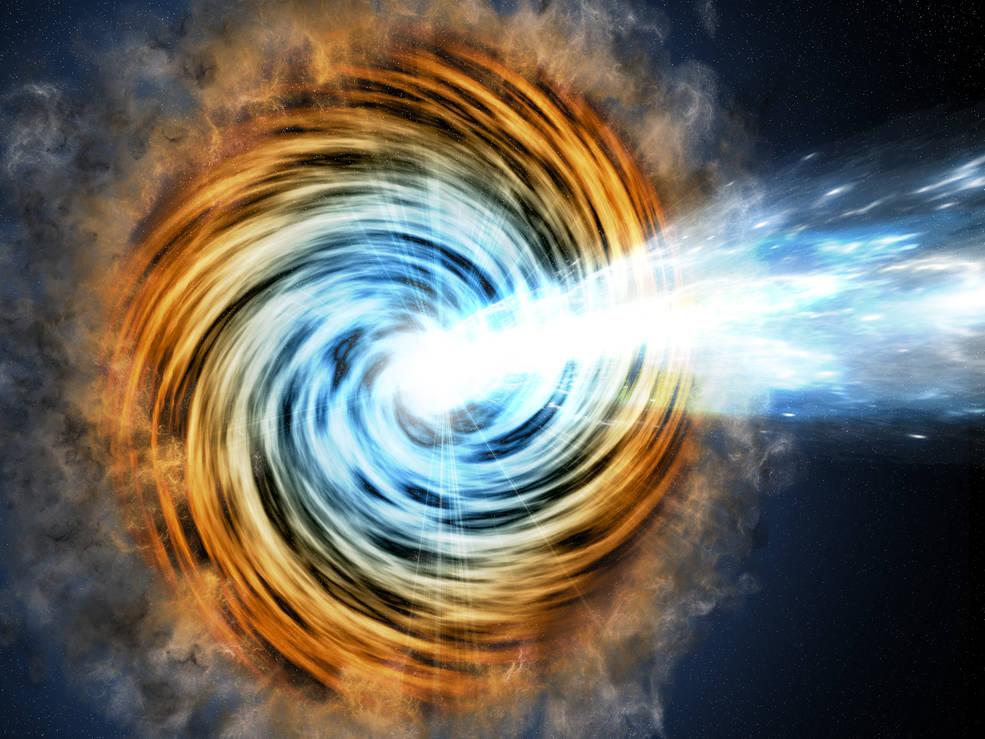
Blazars are galaxies with a jet aimed almost directly at us, and they flicker across every part of the spectrum at once.
Key points
- Focus: Blazars are galaxies with a jet aimed almost directly at us, and they flicker across every part of the spectrum at once
- Detail: Science reporting: verify primary technical documentation
- Editorial reading: science reporting; whenever possible, verify the cited primary source.
Blazars are galaxies with a jet aimed almost directly at us, and they flicker across every part of the spectrum at once. Almost everything we think we know about them comes from short observing campaigns just a handful of days, every year. The science-journalism coverage adds useful context, while the strongest evidential footing still comes from the underlying data, papers or institutional documentation.
That matters because astronomy does not advance on single detections. The field builds confidence by accumulating independent observations across different wavelengths, instruments and epochs until isolated signals become defensible conclusions. What looks convincing in one dataset can dissolve when a second instrument looks at the same target, and what looks marginal can solidify when follow-up campaigns confirm the original reading. The current standard requires that a result survive this triangulation before the community treats it as settled. A Polish and German team has now done the opposite, following a single blazar for nearly twenty years with two orbiting observatories and in two observations from 2012 they found. From that angle the galaxy collapses to a single brilliant point, and it shines across the entire electromagnetic spectrum, from radio waves to gamma rays.
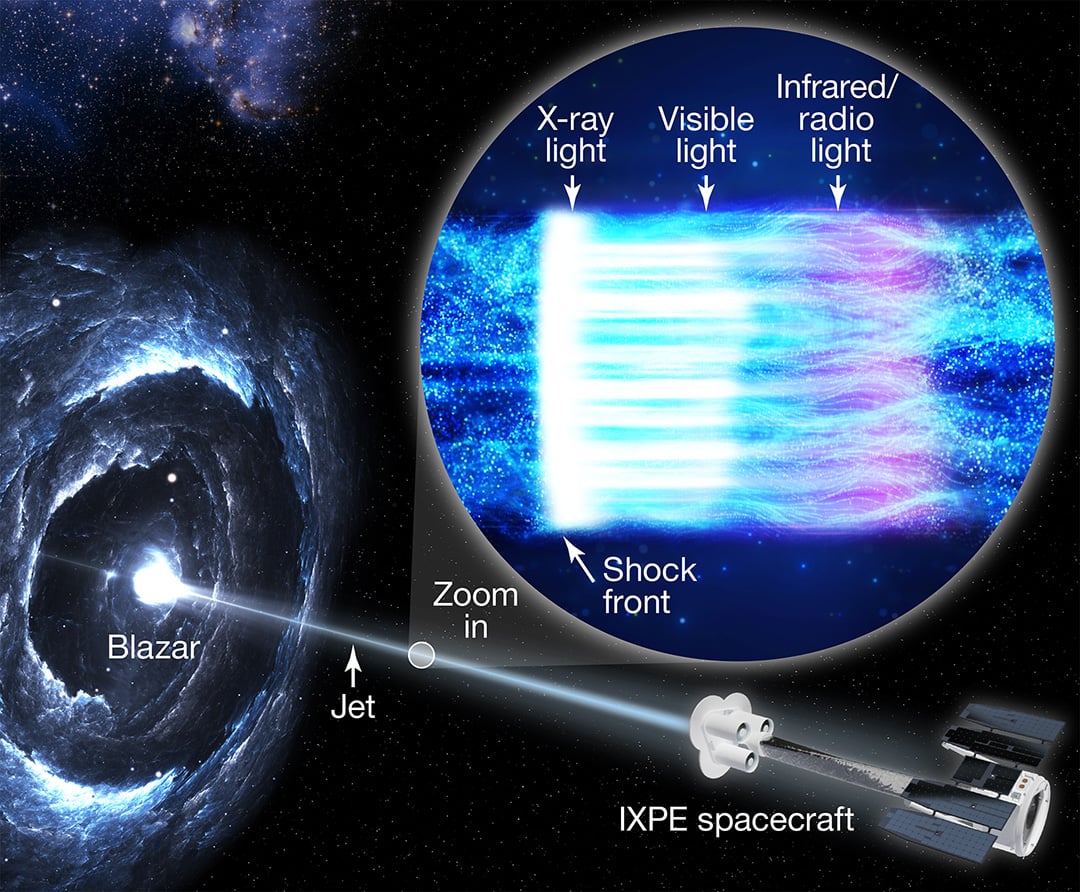
The inset shows high energy particles in blue, the electrons, in the standard picture, produce everything we see Alicja Wierzcholska at the Institute of Nuclear Physics in Cracow. Their target is PKS 2155-304, an unremarkable sounding object a billion and a half light years away in the southern constellation of Piscis Austrinus.
Their data covers almost two decades, drawn from NASA's Swift observatory for the optical, ultraviolet and X-ray, and Fermi for the gamma rays. Look at any individual outburst of PKS 2155-304 and you can see that behaviour but the details differ from flare to flare, and across two decades the pattern doesn't hold.
In two runs from 2012, an extra dip appears in the spectrum, statistically solid, and at a time when the object wasn't flaring at all. High-energy neutrinos have been arriving at Earth for years from sources nobody can identify, and the one solid lead we now have is a blazar, TXS 0506+056, caught mid-outburst.
What gives the story weight is not just the object itself, but the way the measurement trims the range of plausible physical explanations. Astronomy has accumulated enough cases to know that the most interesting results are rarely the ones that confirm expectations cleanly; they are the ones that confirm some expectations while complicating others, or that open a parameter space that previous instruments could not reach. The scientific community evaluates these contributions by asking whether the new data constrain a model in a way that older data could not, and whether those constraints survive systematic review.
Mark is known for his tireless enthusiasm for making science accessible, through numerous tv, radio, podcast and theatre appearances, and books. He was a part of the award-nominated BBC Stargazing LIVE TV Show in the UK and his Spectacular Science theatre show has received 5 star reviews across UK theatres.
Because this item comes through Universe Today as science journalism, it should be treated as contextual reporting rather than primary evidence. Good science reporting can identify why a result matters, connect it to the wider literature and make technical work readable, but the decisive evidence remains in the original paper, dataset, mission release or technical record. That distinction is especially important when a story is later repeated by aggregators, because repetition increases visibility, not evidential strength.
The next step is to see whether other instruments and other wavelengths tell the same story. Campaigns with JWST, the VLT, the forthcoming Extremely Large Telescopes and radio arrays will provide the spectral coverage and spatial resolution needed to move from detection to physical characterization. The timeline for that kind of confirmation is typically measured in years, not months, which is worth keeping in mind when reading the current result.
Original source: Universe Today