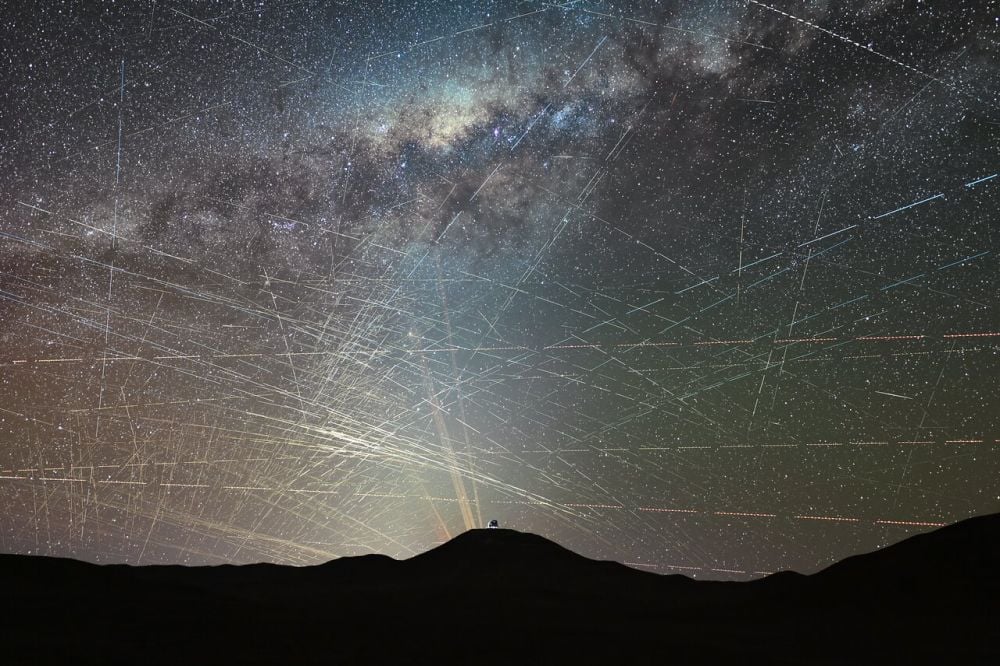
The ESO is Deeply Concerned About Space Data Centers, and the Rest of Us Should Be Too
The European Southern Observatory has expressed its dismay at the approval of SpaceX's satellite AI system.
Key points
- Focus: The European Southern Observatory has expressed its dismay at the approval of SpaceX's satellite AI system
- Detail: Science reporting: verify primary technical documentation
- Editorial reading: science reporting; whenever possible, verify the cited primary source.
The European Southern Observatory has expressed its dismay at the approval of SpaceX's satellite AI system. The system, called Starmind, calls for another 1 million satellites in Low Earth Orbit. The science-journalism coverage adds useful context, while the strongest evidential footing still comes from the underlying data, papers or institutional documentation.
The significance lies in physics only takes a result seriously when the measurement chain remains robust under scrutiny. Experimental particle physics and precision metrology both operate in regimes where the signal sits far below the background noise, and where systematic uncertainties can mimic new physics if not controlled rigorously. The history of the field contains numerous anomalies that generated theoretical excitement before better data showed them to be artifacts, and it also contains genuine discoveries that were initially dismissed as noise. The difference is almost always resolved by independent replication with different instruments and different systematics. The system, called Starmind, calls for another 1 million satellites in Low Earth Orbit. The FCC just approved SpaceX's application to launch a staggering one million new satellites in Low-Earth Orbit (LEO).
The system is designed to avoid using energy and resources here on Earth. The ESO operates some of the most powerful existing and upcoming telescopes in the world in the Atacama Desert in Chile: The Very Large Telescope (VLT), the Atacama Large.
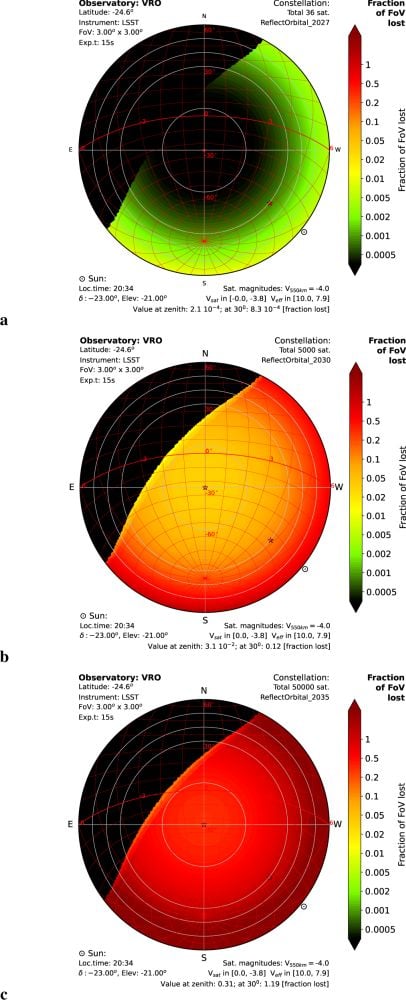
In a new statement, the ESO condemns the Starmind project as a serious detriment to astronomical observations. Their technical analysis is peer-reviewed and was published in Astronomy and Astrophysics in March 2026.
This study evaluates the effect of proposed constellations, ranging from current deployments to mega-constellations and very bright reflector concepts, on direct trail losses. Conversely, mega-constellations with 10 6 satellites render trails pervasive, thereby affecting the majority of long exposures," they write.
The broader interest lies as much in the method as in the headline number, because a durable measurement procedure can travel farther than a single result. When experimental physicists develop a technique that achieves new sensitivity or controls a previously uncharacterized systematic, that methodological contribution persists even if the specific measurement is later revised. This is one reason why precision physics experiments often generate long-term value that is not immediately visible in the original publication.
The ESO's analysis says dryly that they "would substantially degrade astronomical observations. But the real problem astronomers face from Reflect Orbital is that their satellites would blow past the V 550km = 7 threshold.
Because this item comes through Universe Today as science journalism, it should be treated as contextual reporting rather than primary evidence. Good science reporting can identify why a result matters, connect it to the wider literature and make technical work readable, but the decisive evidence remains in the original paper, dataset, mission release or technical record. That distinction is especially important when a story is later repeated by aggregators, because repetition increases visibility, not evidential strength.
The next step is more measurement, tighter systematic control and scrutiny from groups whose experimental setups are genuinely independent. In experimental particle physics and precision metrology, the threshold for a discovery claim is a five-sigma excess surviving multiple analyses; an intriguing signal at lower significance is a reason to run more experiments, not a reason to revise the textbooks. Next-generation experiments currently under construction or commissioning will revisit several of the open questions that give the current result its context.
Original source: Universe Today