First light for PoET: shining (sun)light on exoplanet research
The Paranal solar ESPRESSO Telescope, installed at the European Southern Observatory's Paranal site in Chile, has made its first observations.
Key points
- Focus: The Paranal solar ESPRESSO Telescope, installed at the European Southern Observatory's Paranal site in Chile, has made its first observations
- Detail: Institutional origin: separate announcement from evidence
- Editorial reading: institutional release, useful as a primary source but not independent validation.
The Paranal solar ESPRESSO Telescope, installed at the European Southern Observatory's Paranal site in Chile, has made its first observations. The telescope will work with ESO's ESPRESSO instrument to study the Sun in detail. The institutional report frames the development in practical terms and ties it to the broader mission or observing effort.

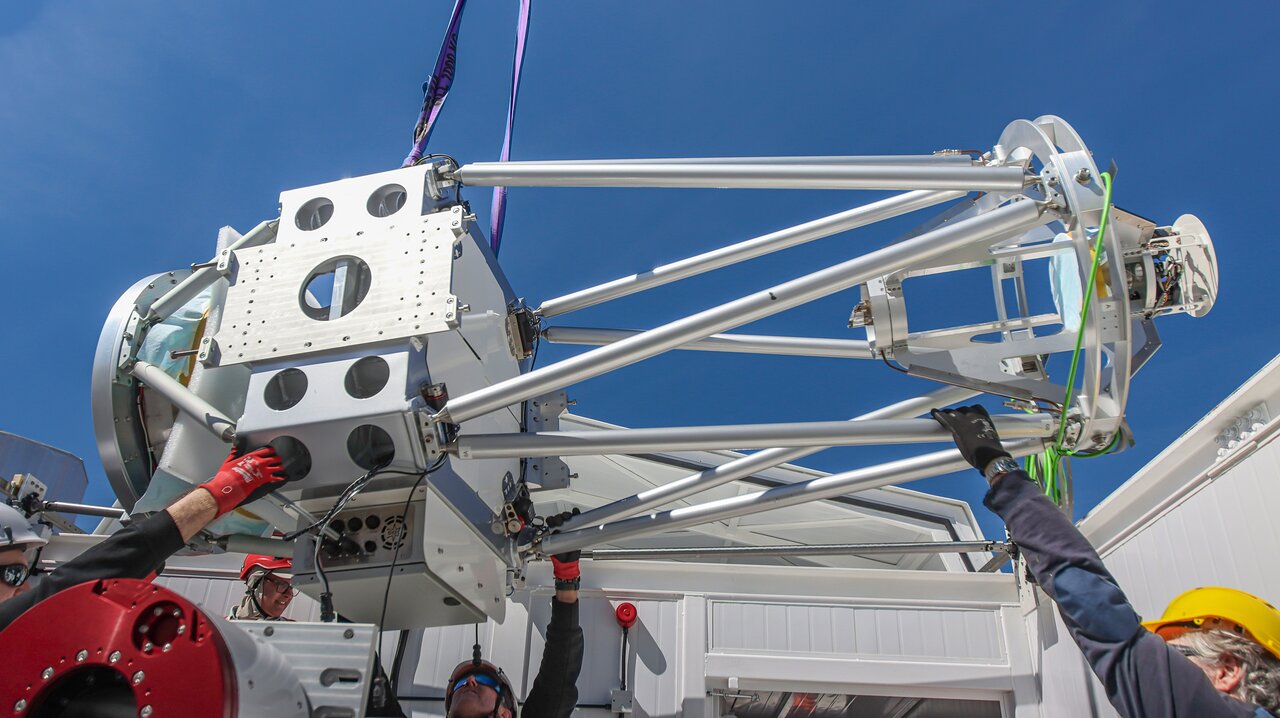
That matters because exoplanet science has moved beyond the era of simple discovery into a period of comparative characterization. With more than five thousand confirmed planets known, the scientifically productive questions now concern atmospheric composition, internal structure, orbital history and the statistical properties of populations rather than the existence of individual worlds. A new detection or spectral measurement is most valuable when it adds a well-constrained data point to those comparative frameworks, not when it stands alone as an anecdote. The Paranal solar ESPRESSO Telescope (PoET), installed at the European Southern Observatory's (ESO's) Paranal site in Chile, has made its first observations. The telescope will work with ESO's ESPRESSO instrument to study the Sun in detail.

PoET observations could be key to the discovery and characterisation of exoplanets, which may currently be hidden in the noise. Much like sunspots alter sunlight, surface activity on other stars distorts their spectrum in a way that can be measured, as ‘noise’, with current exoplanet-hunting.
But removing this noise from the spectra of distant stars is challenging, because we don’t fully understand how stellar activity changes the light we observe. PoET's design makes it uniquely capable of using the Sun to understand the spectra of distant stars.
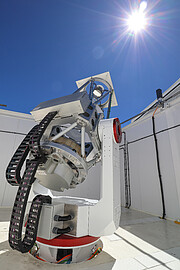
It has a telescope, with a mirror 60-centimetre in diameter, that gathers light from specific areas of the Sun, such as individual sunspots, probing the signatures of stellar. An exoplanet instrument on ESO’s Very Large Telescope (VLT) targeting distant stars by night, ESPRESSO will now also be used with PoET during the day to analyse solar spectra.
The broader interest lies in making the target less anecdotal and more comparable with the rest of the known planetary population. Population-level questions, such as the frequency of atmospheres around small rocky planets or the prevalence of water-rich worlds in the habitable zone, require well-characterized individual data points before statistical patterns become meaningful. Each new planet with a measured radius, mass and, ideally, atmospheric constraint is a brick in that larger structure, and the accumulation of bricks eventually allows theorists to test formation models against real distributions rather than projections.
By switching from the VLT at night to PoET during the day, we maximise the usage of this instrument to help us find and characterise exoplanets,” says ESO’s Alain Smette, VLT. PoET was designed and developed in Portugal, with funds from the European Research Council, and a team of 12 Portuguese researchers were present at the installation and testing.
Because the account originates with ESO Press Releases, it functions best as a primary institutional report that is close to the data and operations, not as independent scientific validation. Institutional communications are produced by organizations with legitimate interests in presenting their work in a favorable light, which does not make them unreliable but does make them partial. Details that complicate the narrative, including instrument limitations, unexpected failures and results below projections, tend to be minimized relative to progress messages. Technical documentation and peer-reviewed publications, where they exist, provide the complementary layer that institutional releases cannot substitute.
The next step is to improve independent constraints on the mass, radius, atmospheric composition and orbital dynamics of the target. Transmission spectroscopy with JWST, radial velocity campaigns with high-resolution ground-based spectrographs and phase-curve measurements from space photometry represent the observational toolkit that can move characterization from plausible to robust. That convergence of techniques is the standard the community now expects before a planetary atmosphere result is treated as confirmed.


Editorial context
Institutional source
Primary institutional source. Useful for first disclosure and operational context, but not a substitute for independent validation.
Original source: ESO Press Releases