First Direct Measurement of Cosmic Hydrogen Could Change How We Map the Universe
The MeerKLASS international collaboration achieves the first direct measurement of the large-scale clustering of cosmic hydrogen in the Universe.
Key points
- Focus: The MeerKLASS international collaboration achieves the first direct measurement of the large-scale clustering of cosmic hydrogen in the Universe
- Detail: Science reporting: verify primary technical documentation
- Editorial reading: science reporting; whenever possible, verify the cited primary source.
The MeerKLASS international collaboration achieves the first direct measurement of the large-scale clustering of cosmic hydrogen in the Universe. The science-journalism coverage adds useful context, while the strongest evidential footing still comes from the underlying data, papers or institutional documentation.
It is relevant because astronomy does not advance on single detections. The field builds confidence by accumulating independent observations across different wavelengths, instruments and epochs until isolated signals become defensible conclusions. What looks convincing in one dataset can dissolve when a second instrument looks at the same target, and what looks marginal can solidify when follow-up campaigns confirm the original reading. The current standard requires that a result survive this triangulation before the community treats it as settled. The MeerKLASS (MeerKAT Large Area Synoptic Survey) Collaboration is an international group of astronomers conducting cosmological surveys using the MeerKAT radio telescope. Their survey relies on a technique known as HI intensity (or 21-cm intensity) mapping to detect the combined emissions of galaxies within large segments of the sky.
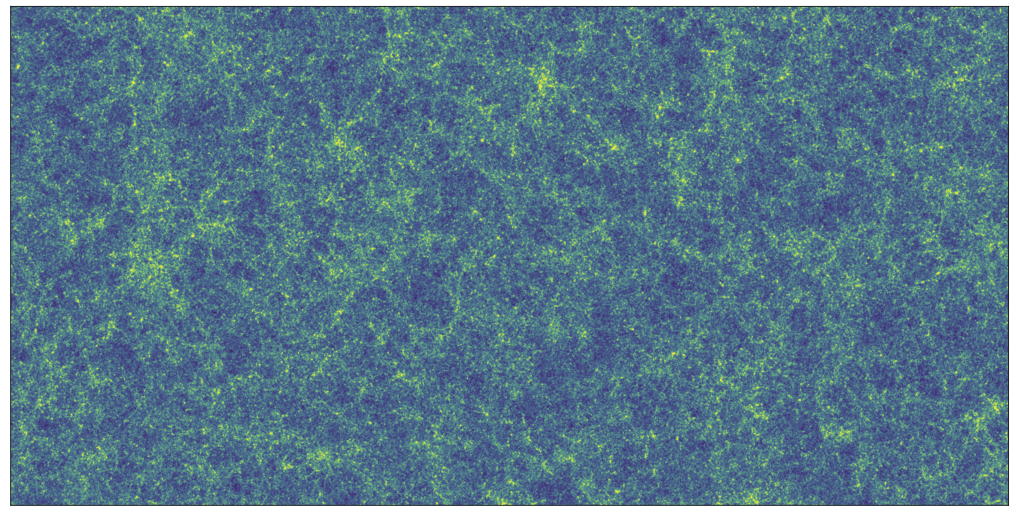
This enables the creation of 3D maps of the cosmos that show the distribution of matter (gas, dust, stars, galaxies, clusters, etc. ) in the cosmic web. SARAO This is no easy task, since the 21-cm signal must be extracted from all the other emissions of the Universe (the "foreground noise"), which are about 10, 000 times stronger.
For their survey, the team analyzed data collected by the MeerKAT array across ~250 square degrees of sky. This enabled the detection of a neutral hydrogen signal that originated 4.5 billion years ago (or 9 billion years after the Big Bang).
The team's measurements produced many independent maps from different dishes and observing times. This slice of the DESI data maps celestial objects from Earth (center) to billions of light-years away, showing nearby bright galaxies (yellow), luminous red galaxies (orange).
What gives the story weight is not just the object itself, but the way the measurement trims the range of plausible physical explanations. Astronomy has accumulated enough cases to know that the most interesting results are rarely the ones that confirm expectations cleanly; they are the ones that confirm some expectations while complicating others, or that open a parameter space that previous instruments could not reach. The scientific community evaluates these contributions by asking whether the new data constrain a model in a way that older data could not, and whether those constraints survive systematic review.
And none of it would exist without the South African Radio Astronomy Observatory, which built and operates MeerKAT and helped sort out the many challenges with this survey along. Matt Williams is a space journalist, science communicator, and author with several published titles and studies.
Because this item comes through Universe Today as science journalism, it should be treated as contextual reporting rather than primary evidence. Good science reporting can identify why a result matters, connect it to the wider literature and make technical work readable, but the decisive evidence remains in the original paper, dataset, mission release or technical record. That distinction is especially important when a story is later repeated by aggregators, because repetition increases visibility, not evidential strength.
The next step is to see whether other instruments and other wavelengths tell the same story. Campaigns with JWST, the VLT, the forthcoming Extremely Large Telescopes and radio arrays will provide the spectral coverage and spatial resolution needed to move from detection to physical characterization. The timeline for that kind of confirmation is typically measured in years, not months, which is worth keeping in mind when reading the current result.
Original source: Universe Today