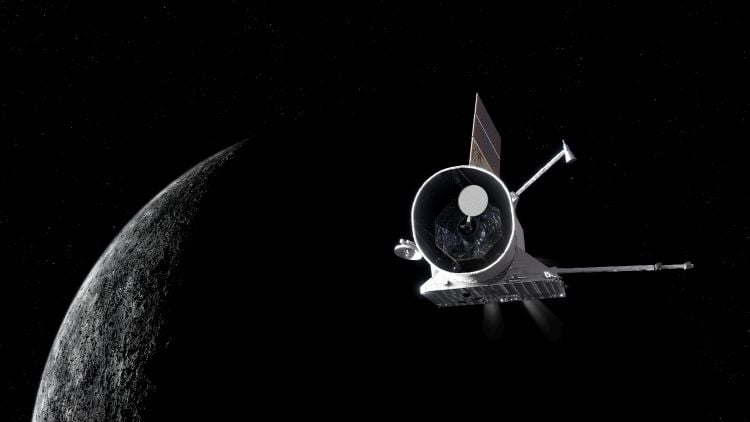
BepiColombo Captures Mercury Orbit After 8-Year Trip
The planet Mercury might be one of the least explored planetary bodies in the solar system, but its is arguably the most crucial in helping scientists better understand the.
Key points
- Focus: The planet Mercury might be one of the least explored planetary bodies in the solar system, but its is arguably the most crucial in helping
- Detail: Science reporting: verify primary technical documentation
- Editorial reading: science reporting; whenever possible, verify the cited primary source.
The planet Mercury might be one of the least explored planetary bodies in the solar system, but its is arguably the most crucial in helping scientists better understand the formation and evolution of the inner solar system. The science-journalism coverage adds useful context, while the strongest evidential footing still comes from the underlying data, papers or institutional documentation.
It is relevant because Earth science becomes stronger when local observations can be placed inside a broader physical pattern that spans time and geography. The planet operates as a coupled system in which atmospheric, oceanic, cryospheric and solid-Earth processes interact across timescales from days to millions of years. A measurement that captures one variable at one location and one moment has limited interpretive value until it is embedded in the longer series and wider spatial coverage that allow natural variability to be separated from forced change. Its position as the closest planet to the Sun makes it a prime target for how the rocky planets formed and evolved and what this could mean for finding life beyond Earth. Now, the lauded joint mission between the European Space Agency (ESA) and the Japan Aerospace Exploration Agency (JAXA) called BepiColombo might have just become the second.
This is because mission leaders recently announced that BepiColombo successfully achieved Mercury orbit insertion (MOI) on November 21 at 18: 27 UTC (1: 27 pm EST/10: 27 am PST). This historic achievement comes 8 years, 1 month, and 1 day since BepiColombo launched on October 20, 2018, and included one Earth flyby, two Venus flybys, and six mercury flybys.
While MOI is essential for achieving Mercurian orbit, it is not the final orbit BepiColombo will achieve to conduct science operations, which are expected to commence in April. The first science operations phase is slated to run from April 2027 to April 2028 with a potential extended mission from April 2028 to December 2029.
If the mission is extended until December 2029, the team will then assess the spacecraft’s remaining fuel and determine if continued science operations can be achieved or if it. Our almost 600-strong science team will be delighted to see BepiColombo pass this key milestone and begin revealing more about Mercury, from its interior and surface to the space.
The broader interest lies in linking the observation to climatic, geophysical or environmental dynamics that extend well beyond the immediate event or location. Earth science is unusual in that its most important questions operate on timescales that no single research career can observe directly, making the archival record, whether in ice, sediment, rock or satellite data, as important as any new measurement. Results that can be embedded in that record, and that either confirm or challenge the patterns it reveals, carry disproportionate scientific weight.
Geraint Jones, who is the Lead Project Scientist for ESA’s BepiColombo and was previously was a Professor of Planetary Science and Head of the Planetary Science Group at. As noted, BepiColombo just became the second mission to successfully orbit Mercury, with the first being NASA’s MESSENGER (MErcury Surface, Space ENvironment, GEochemistry, and.
Because this item comes through Universe Today as science journalism, it should be treated as contextual reporting rather than primary evidence. Good science reporting can identify why a result matters, connect it to the wider literature and make technical work readable, but the decisive evidence remains in the original paper, dataset, mission release or technical record. That distinction is especially important when a story is later repeated by aggregators, because repetition increases visibility, not evidential strength.
The next step is to place the result inside longer time series and to compare it with independent instruments and independent sites. Earth system observations gain most of their interpretive power from network density and temporal depth, not from any single measurement however precise. Model simulations that assimilate the new data will help clarify whether the observation fits comfortably within known natural variability or represents a shift that existing models do not reproduce.
Original source: Universe Today