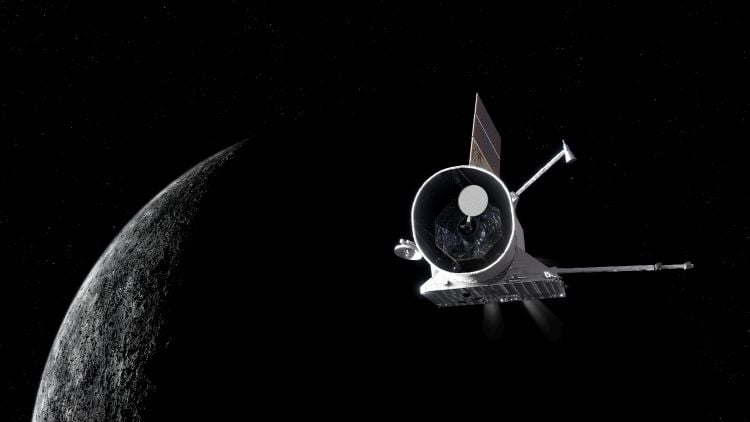
BepiColombo Captures Mercury Orbit After 8-Year Trip
The planet Mercury might be one of the least explored planetary bodies in the solar system, but its is arguably the most crucial in helping scientists better understand the.
Pontos-chave
- Em foco: The planet Mercury might be one of the least explored planetary bodies in the solar system, but its is arguably the most crucial in helping
- Detalhe: Cobertura jornalística: verificar documentação técnica primária
- Leitura editorial: reportagem científica; quando possível, confira a fonte primária citada.
The planet Mercury might be one of the least explored planetary bodies in the solar system, but its is arguably the most crucial in helping scientists better understand the formation and evolution of the inner solar system. Its position as the closest planet to the Sun makes it a prime target for how the rocky planets formed and evolved and what this could mean for finding life beyond Earth.
Now, the lauded joint mission between the European Space Agency (ESA) and the Japan Aerospace Exploration Agency (JAXA) called BepiColombo might have just become the second mission to orbit Mercury. This is because mission leaders recently announced that BepiColombo successfully achieved Mercury orbit insertion (MOI) on November 21 at 18: 27 UTC (1: 27 pm EST/10: 27 am PST).
This historic achievement comes 8 years, 1 month, and 1 day since BepiColombo launched on October 20, 2018, and included one Earth flyby, two Venus flybys, and six mercury flybys to achieve orbit just a few days ago. While MOI is essential for achieving Mercurian orbit, it is not the final orbit BepiColombo will achieve to conduct science operations, which are expected to commence in April 2027.
The first science operations phase is slated to run from April 2027 to April 2028 with a potential extended mission from April 2028 to December 2029. If the mission is extended until December 2029, the team will then assess the spacecraft’s remaining fuel and determine if continued science operations can be achieved or if it will crash into Mercury’s surface.
Our almost 600-strong science team will be delighted to see BepiColombo pass this key milestone and begin revealing more about Mercury, from its interior and surface to the space around it,” said Dr. Geraint Jones, who is the Lead Project Scientist for ESA’s BepiColombo and was previously was a Professor of Planetary Science and Head of the Planetary Science Group at University College London's Mullard Space Science Laboratory (UK).
As noted, BepiColombo just became the second mission to successfully orbit Mercury, with the first being NASA’s MESSENGER (MErcury Surface, Space ENvironment, GEochemistry, and Ranging) spacecraft, which orbited Mercury from March 2011 to April 2015 after initial estimates put.
Fonte original: Universe Today