NASA’s Titan-Bound Dragonfly Rotorcraft Gets Its Eyes
Science instruments for NASA’s Dragonfly are starting to arrive at the Johns Hopkins Applied Physics Laboratory in Laurel, Maryland, where the car-sized rotorcraft is coming.
Pontos-chave
- Em foco: Science instruments for NASA’s Dragonfly are starting to arrive at the Johns Hopkins Applied Physics Laboratory in Laurel, Maryland, where the
- Detalhe: Origem institucional: distinguir anúncio de evidência
- Leitura editorial: release institucional, útil como fonte primária, mas não como validação independente.
Science instruments for NASA’s Dragonfly are starting to arrive at the Johns Hopkins Applied Physics Laboratory in Laurel, Maryland, where the car-sized rotorcraft is coming together for its mission to explore Saturn’s largest moon, Titan. Science instruments for NASA’s Dragonfly are starting to arrive at the Johns Hopkins Applied Physics Laboratory (APL) in Laurel, Maryland, where the car-sized rotorcraft is coming together for its mission to explore Saturn’s largest moon, Titan.
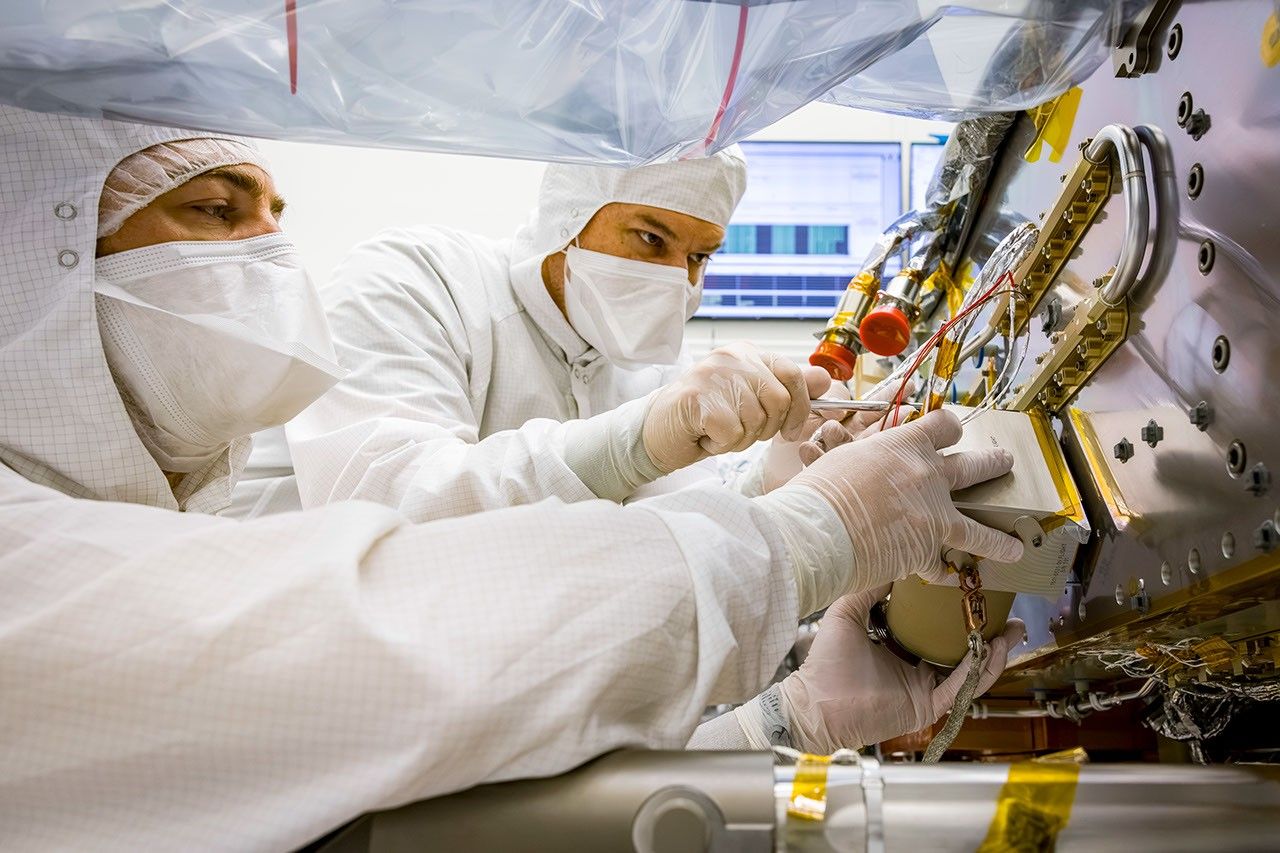
From left, technicians Chad Cook and Seth Harvey install the high-resolution microscopic imager, part of the seven-camera DragonCam science imaging suite, onto NASA’s Dragonfly rotorcraft at the Johns Hopkins Applied Physics Laboratory (APL) in Laurel, Maryland, on Nov. NASA/Johns Hopkins APL/Ed Whitman First to check in: DragonCam, which consists of seven cameras designed to characterize Titan ’s surface at multiple scales during flight and while on the ground.
NASA/Johns Hopkins APL/MSSS Two downward-facing WACs provide views of the surface beneath Dragonfly, helping the mission team decide if a landing spot is safe for deploying Dragonfly’s sample-collecting tool, known as DrACO, or Drill for Acquisition of Complex Organics, and its. We’ll be collecting materials at multiple sites across Titan, and the images from the cameras will help us relate the samples to Titan’s broader landscape and piece together the story of its geology.
This animation highlights the elements of DragonCam and how its imaging capabilities will support Dragonfly’s scientific investigations NASA/Johns Hopkins APL/Zac Swanson Components of Dragonfly’s other instrument packages. Maryland, where the car-sized rotorcraft is coming together for its mission to explore Saturn’s largest moon.
Each camera will look out at Titan through a window in a foam enclosure that insulates the cameras and Dragonfly’s interior from Titan’s cryogenic environment, where ambient temperatures reach minus 290 degrees Fahrenheit. A configurable LED array, built at APL and spanning the light spectrum from the infrared to the ultraviolet, provides information about the color of surface materials at the sampling site and helps scientists make inferences about their composition.
We are extremely pleased to have delivered the DragonCam cameras,” said Michael Ravine, DragonCam development manager and a Dragonfly co-investigator from Malin Space Science Systems.
Fonte original: NASA News Releases