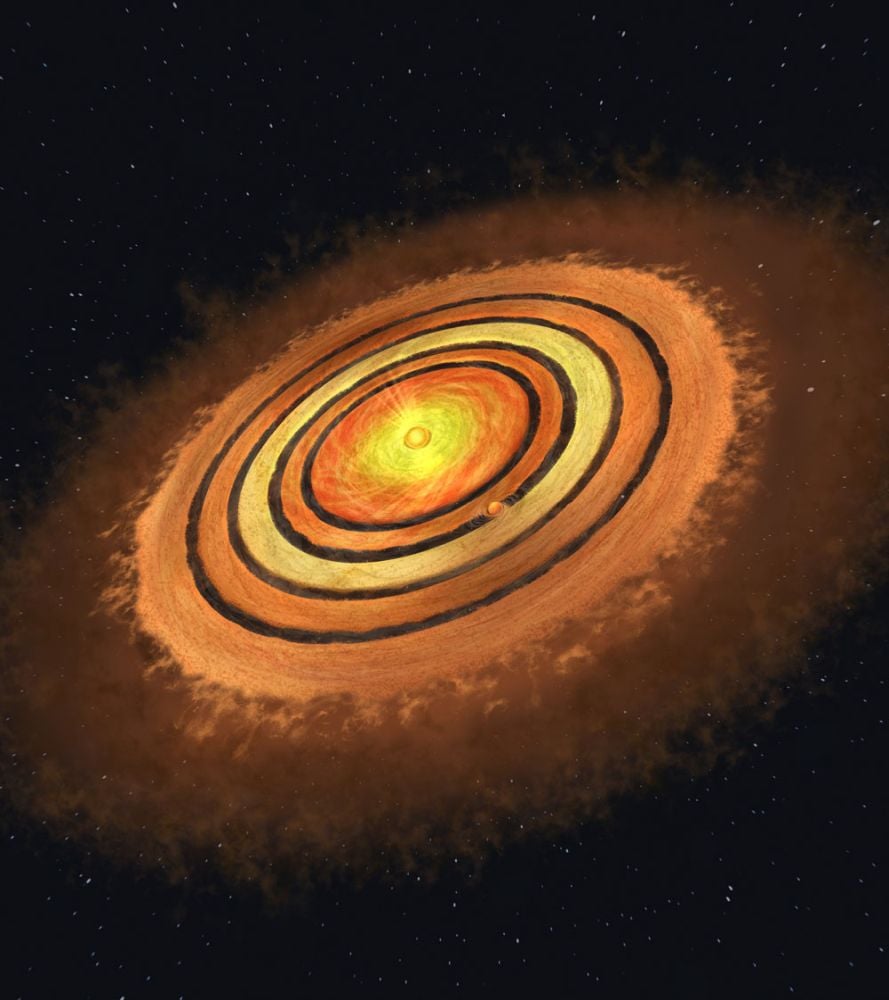
All the Gaps We See in Protoplanetary Disks Aren't From Planets
Astronomers have observed dozens of protoplanetary disks around young stars.
Pontos-chave
- Em foco: Astronomers have observed dozens of protoplanetary disks around young stars. ALMA has proven to be especially effective at this task
- Detalhe: Cobertura jornalística: verificar documentação técnica primária
- Leitura editorial: reportagem científica; quando possível, confira a fonte primária citada.
Astronomers have observed dozens of protoplanetary disks around young stars. ALMA has proven to be especially effective at this task.
These new stars have bright rings and dark gaps patterned in concentric circles resembling the grooves of a vinyl record,” said Masayuki Yamaguchi, a post-Doctoral Fellow from Kyushu University’s Faculty of Science. V1094 Sco has a protoplanetary disk that extends out to 300 astronomical units, with multiple ring-gap pairs at great distances from the star.
The researchers used ALMA images and observations with the Very Large Telescope's SPHERE (Spectro-Polarimetric High-contrast Exoplanet REsearch) instrument to analyze the V1094 Sco disk. The continuum image shows four narrow dust ring, gap pairs extending to exceptionally large radii (r ∼ 380 au)," they write, and also "trace a spatially extended gas disk (r ∼ 760 au) in Keplerian rotation.
Young stars with protoplanetary disks are T-Tauri stars, and among that group, V1094 Sco is known for having a giant disk with multiple rings, making it a rarity. It was first recognized for its extended ring with multiple gaps and rings in a 2018 paper.
That paper said, "In this work, the nature of V1094 Sco as a giant, multi-ringed protoplanetary disk is identified for the first time, based on data from the Lupus survey of protoplanetary disks. " (The Lupus survey was an ALMA survey of disks in the Lupus star-forming complex. In an interesting twist, the researchers didn't use new ALMA observing time to study V1094 Sco.
We observed that the disk extends approximately 380 astronomical units (AU)—about 13 times the distance between the Sun and Neptune, from the center.

Fonte original: Universe Today