This Gamma-Ray Burst Wasn't Dim, It Was Just Misunderstood
In March 2026, NASA's Fermi Gamma-ray Space Telescope detected a GRB with an unusual light signature.
Key points
- Focus: In March 2026, NASA's Fermi Gamma-ray Space Telescope detected a GRB with an unusual light signature
- Detail: Science reporting: verify primary technical documentation
- Editorial reading: science reporting; whenever possible, verify the cited primary source.
In March 2026, NASA's Fermi Gamma-ray Space Telescope detected a GRB with an unusual light signature. Its initial gamma radiation was dim, and the afterglow exhibited unusual, delayed peaks. The science-journalism coverage adds useful context, while the strongest evidential footing still comes from the underlying data, papers or institutional documentation.
It matters because astrophysics becomes persuasive only when an observed signal can be tied to a physically defensible explanation. Compact objects such as neutron stars and black holes are natural laboratories for extreme physics, but the distance and complexity of these systems make interpretation difficult without multi-wavelength coverage and careful modeling. A detection without a mechanism is only half a result. the other half comes from showing that the signal fits quantitatively inside a coherent physical picture rather than merely being consistent with a broad family of models. They were first detected by accident in the 1960s by a satellite watching for covert nuclear weapons tests, an unnatural, Earthly source of gamma radiation. Now we've detected large numbers of GRBs with satellites dedicated to sensing them.
A typical GRB from a supernova lasts about 20 or 30 seconds, followed by an afterglow with stages of declining energy. (Another class of GRBs, short GRBs, are separate and have a different source. ) On March 10, 2026, NASA’s Fermi Gamma-ray Space Telescope detected a GRB with an unusual light.
Their results are in research titled " An Extremely Bright Slow-rising Afterglow from an Off-axis Jet in GRB 260310A," published in The Astrophysical Journal Letters. Once the Fermi Gamma-Ray Telescope detected GRB 260310A, it sent out alerts for quick follow-up observations.
We present a multiwavelength study of GRB 260310A, a nearby long-duration gamma-ray burst (GRB) at z ≃ 0.153 associated with a broad-lined Type Ic supernova," the authors write. Despite its modest prompt gamma-ray output, GRB 260310A exhibits one of the brightest afterglows ever observed in the X-ray, optical, and radio bands.
The broader interest lies in turning an observational clue into something that can be weighed against competing models of the underlying physics. Astrophysics does not have the luxury of controlled experiments; everything is inferred from radiation that traveled across cosmic distances under conditions that cannot be reproduced in a terrestrial laboratory. This makes the interpretation chain longer and more uncertain than in bench science, but it also means that a well-constrained measurement of an extreme object carries theoretical information that no earthbound experiment can provide.
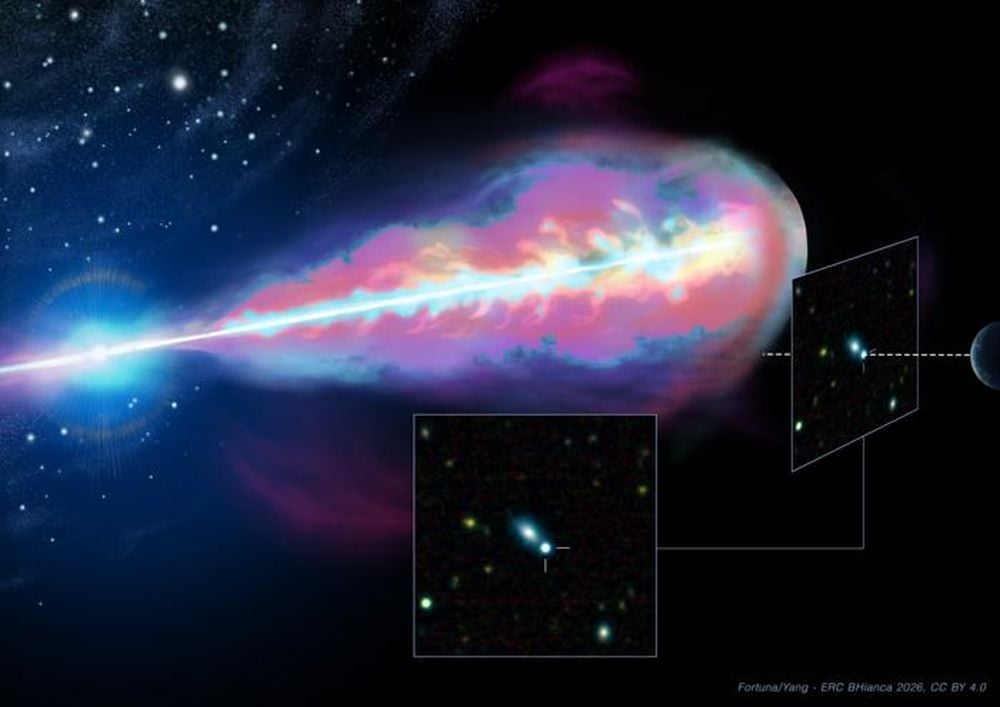
This burst gave us a chance to look beyond that glare. " GRB 260310A wasn't pointed at us, and that explains some of its unusual light pattern, especially its weaker initial gamma. This prompted us to explore a more complex jet’s shape. ” Only NASA's Chandra X-ray Observatory has the angular resolution required to detect a contaminating source, and the.
Because this item comes through Universe Today as science journalism, it should be treated as contextual reporting rather than primary evidence. Good science reporting can identify why a result matters, connect it to the wider literature and make technical work readable, but the decisive evidence remains in the original paper, dataset, mission release or technical record. That distinction is especially important when a story is later repeated by aggregators, because repetition increases visibility, not evidential strength.
The next step is to see whether independent datasets and physical modeling converge on the same interpretation. Multi-wavelength follow-up, combining X-ray, radio and optical data where possible, is typically what separates a compelling detection from a robust physical characterization. In high-energy astrophysics, results that initially looked definitive have been revised when data from a second messenger arrived; the current result should be read with that history in mind.
Original source: Universe Today