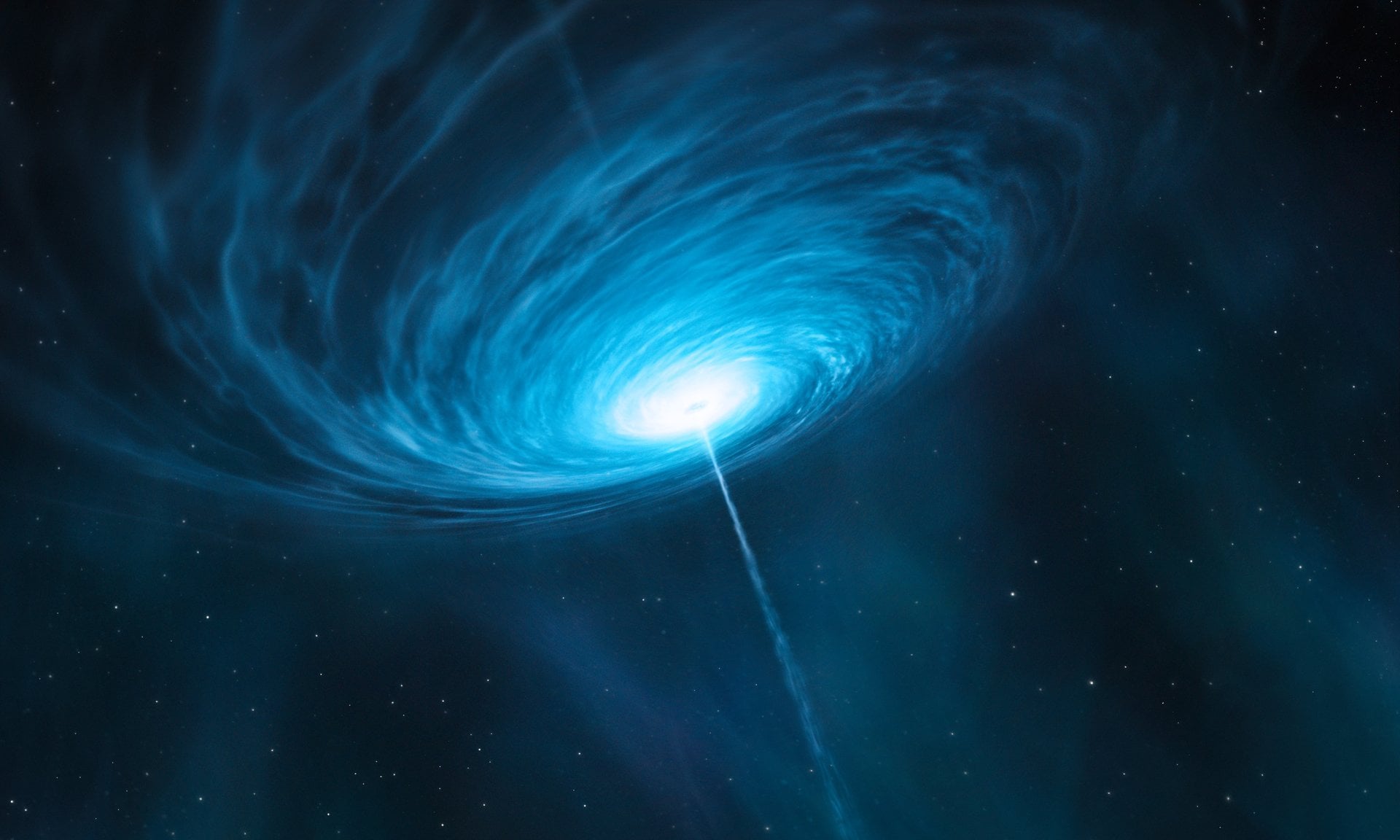
The Event Horizon Telescope Views the Dynamics and Geometry of a Black Hole Jet in Extreme Detail
Observations by the Event Horizon Telescope Collaboration resolved the innermost region of the blazar 3C 279 powerful jet emitted in unprecedented detail.
Key points
- Focus: Observations by the Event Horizon Telescope Collaboration resolved the innermost region of the blazar 3C 279 powerful jet emitted in unprecedented
- Detail: Science reporting: verify primary technical documentation
- Editorial reading: science reporting; whenever possible, verify the cited primary source.
Observations by the Event Horizon Telescope Collaboration resolved the innermost region of the blazar 3C 279 powerful jet emitted in unprecedented detail. The science-journalism coverage adds useful context, while the strongest evidential footing still comes from the underlying data, papers or institutional documentation.
The broader interest lies in turning an observational clue into something that can be weighed against competing models of the underlying physics. Astrophysics does not have the luxury of controlled experiments; everything is inferred from radiation that traveled across cosmic distances under conditions that cannot be reproduced in a terrestrial laboratory. This makes the interpretation chain longer and more uncertain than in bench science, but it also means that a well-constrained measurement of an extreme object carries theoretical information that no earthbound experiment can provide.
Because this item comes through Universe Today as science journalism, it should be treated as contextual reporting rather than primary evidence. Good science reporting can identify why a result matters, connect it to the wider literature and make technical work readable, but the decisive evidence remains in the original paper, dataset, mission release or technical record. That distinction is especially important when a story is later repeated by aggregators, because repetition increases visibility, not evidential strength.
The next step is to see whether independent datasets and physical modeling converge on the same interpretation. Multi-wavelength follow-up, combining X-ray, radio and optical data where possible, is typically what separates a compelling detection from a robust physical characterization. In high-energy astrophysics, results that initially looked definitive have been revised when data from a second messenger arrived; the current result should be read with that history in mind.
Original source: Universe Today