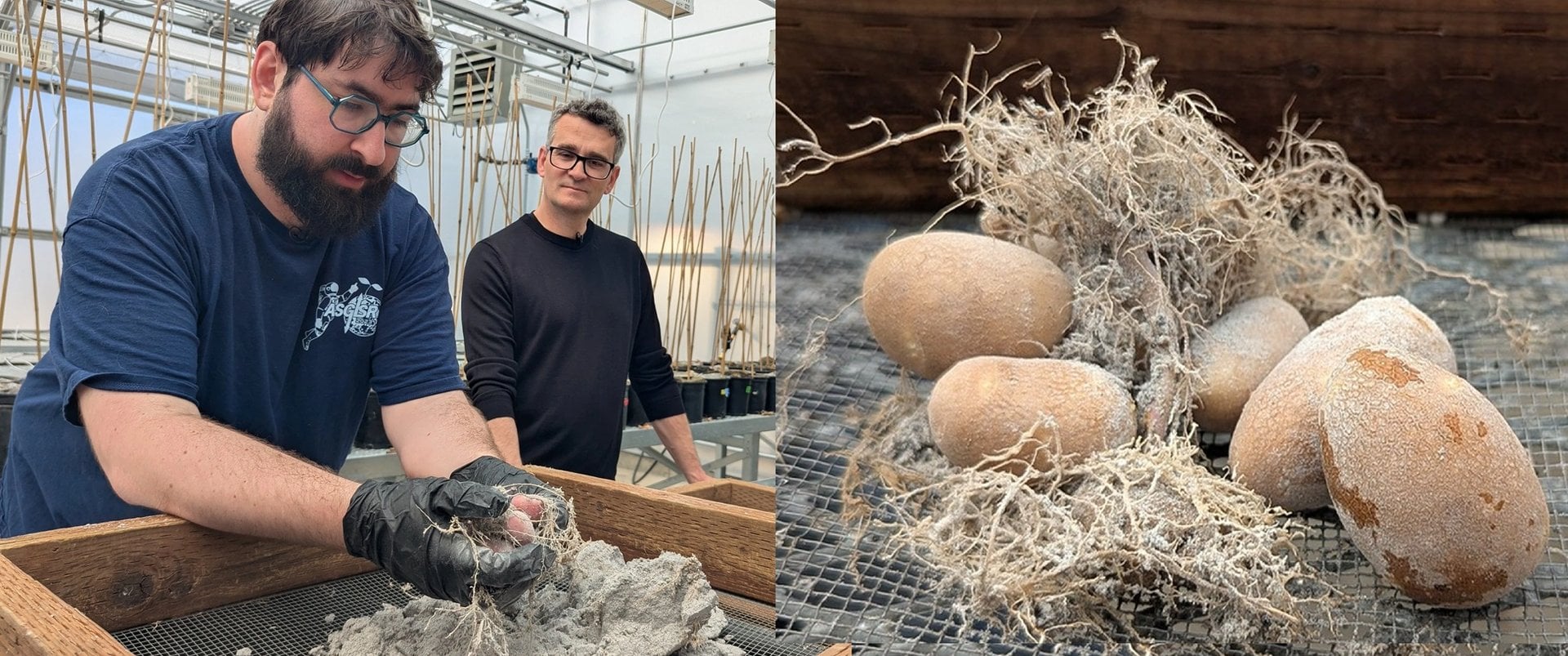
Study Finds Artemis Astronauts Will Enjoy Moon-Grown Potatoes
Researchers have shown that potatoes grown in simulated lunar soil fortified with organic matter are safe to eat and can achieve growth and yields comparable to those produced on.
Key points
- Focus: Researchers have shown that potatoes grown in simulated lunar soil fortified with organic matter are safe to eat and can achieve growth and yields
- Detail: Science reporting: verify primary technical documentation
- Editorial reading: science reporting; whenever possible, verify the cited primary source.
Shown that potatoes grown in simulated lunar soil fortified with organic matter are safe to eat and can achieve growth and yields comparable to those produced on Earth. The science-journalism coverage adds useful context, while the strongest evidential footing still comes from the underlying data, papers or institutional documentation.
It matters because Earth science becomes stronger when local observations can be placed inside a broader physical pattern that spans time and geography. The planet operates as a coupled system in which atmospheric, oceanic, cryospheric and solid-Earth processes interact across timescales from days to millions of years. A measurement that captures one variable at one location and one moment has limited interpretive value until it is embedded in the longer series and wider spatial coverage that allow natural variability to be separated from forced change. The latest comes from Oregon State University (OSU), where researchers have shown that potatoes grown in lunar soil simulant (amended with organic matter) are safe to eat and grow. To support long-term missions far from Earth, where opportunities for resupply will be fewer and farther between, a degree of self-sufficiency is required.
Research in the past few decades has led to methods for 3D printing habitats and other facilities using lunar regolith. With support from NASA's Johnson Space Center Simulant Development Lab, the team produced healthy potatoes with yields comparable to crops grown by farmers in Oregon (the 4th.
The results showed that potato plants grown in simulants containing 30% vermicompost grew as well as those cultivated in Earth soils. ESA/Skidmore, Owings & Merrill Lastly, those grown with 5% to 15% vermicompost showed only partial growth.
In the future, astronauts could bring compost to the Moon, along with Earth worms, to create their own fertilizer, augmenting soil collected during surface trips to grow their. Another paper, which reports the results of experiments involving 10 potato varieties to identify which grow best in lunar soil, will be released.
The broader interest lies in linking the observation to climatic, geophysical or environmental dynamics that extend well beyond the immediate event or location. Earth science is unusual in that its most important questions operate on timescales that no single research career can observe directly, making the archival record, whether in ice, sediment, rock or satellite data, as important as any new measurement. Results that can be embedded in that record, and that either confirm or challenge the patterns it reveals, carry disproportionate scientific weight.
Matt Williams is a space journalist, science communicator, and author with several published titles and studies. His work is featured in The Ross 248 Project and Interstellar Travel edited by NASA alumni Les Johnson and Ken Roy.
Because this item comes through Universe Today as science journalism, it should be treated as contextual reporting rather than primary evidence. Good science reporting can identify why a result matters, connect it to the wider literature and make technical work readable, but the decisive evidence remains in the original paper, dataset, mission release or technical record. That distinction is especially important when a story is later repeated by aggregators, because repetition increases visibility, not evidential strength.
The next step is to place the result inside longer time series and to compare it with independent instruments and independent sites. Earth system observations gain most of their interpretive power from network density and temporal depth, not from any single measurement however precise. Model simulations that assimilate the new data will help clarify whether the observation fits comfortably within known natural variability or represents a shift that existing models do not reproduce.

Original source: Universe Today