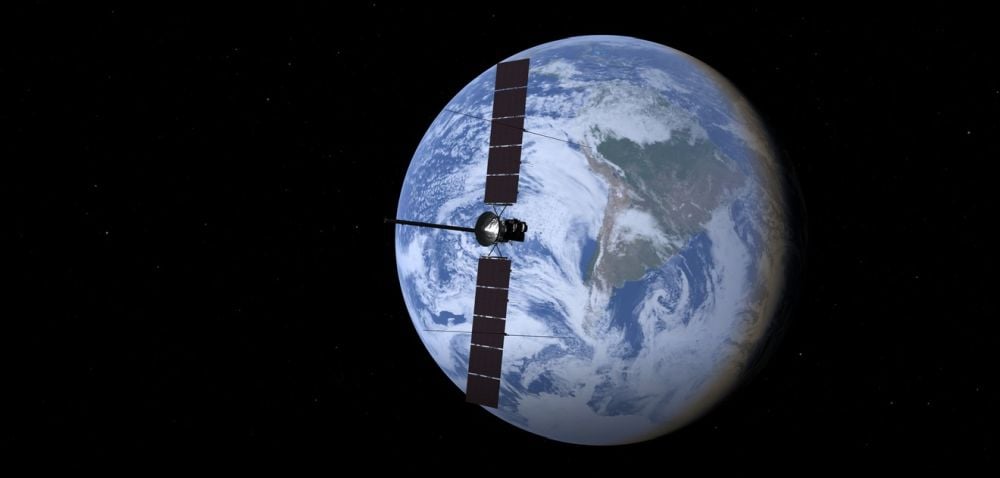
Slingshot Earth: NASA's Europa Clipper Will Gain Speed and Tests Its Instruments During Its Earth Flyby
It is relevant because Earth science becomes stronger when local observations can be placed inside a broader physical pattern that spans time and geography.
Key points
- Focus: NASA's Europa Clipper launched in October 2024, on its way to the Jupiter system. But it hasn't left the inner Solar System yet
- Detail: Science reporting: verify primary technical documentation
- Editorial reading: science reporting; whenever possible, verify the cited primary source.
NASA's Europa Clipper launched in October 2024, on its way to the Jupiter system. But it hasn't left the inner Solar System yet. It used a gravity braking maneuver at Mars in March 2025 to direct it back toward Earth. The science-journalism coverage adds useful context, while the strongest evidential footing still comes from the underlying data, papers or institutional documentation.
It is relevant because Earth science becomes stronger when local observations can be placed inside a broader physical pattern that spans time and geography. The planet operates as a coupled system in which atmospheric, oceanic, cryospheric and solid-Earth processes interact across timescales from days to millions of years. A measurement that captures one variable at one location and one moment has limited interpretive value until it is embedded in the longer series and wider spatial coverage that allow natural variability to be separated from forced change. NASA's Europa Clipper launched in October 2024, on its way to the Jupiter system. It used a gravity braking maneuver at Mars in March 2025 to direct it back toward Earth.
The Europa Clipper performed one of these earlier in its mission, to set it up for the gravity-assist with Earth. The Europa Clipper is NASA's largest deep space mission, and this Earth flyby is critical to accelerating it toward Jupiter.
So was its gravity braking maneuver at Mars in March, 2025, which slowed it down so it could perform this upcoming flyby of Earth. All 11 of the Europa Clipper's science instruments will be active during the flyby.
The mission has nine science teams organized around the 11 instruments, and each team will take the relevant data and compare it to known data about Earth. The flyby will enable us to calibrate the instrument absolutely, using its observations at Earth to refine other calibrations done before launch and in flight.
The broader interest lies in linking the observation to climatic, geophysical or environmental dynamics that extend well beyond the immediate event or location. Earth science is unusual in that its most important questions operate on timescales that no single research career can observe directly, making the archival record, whether in ice, sediment, rock or satellite data, as important as any new measurement. Results that can be embedded in that record, and that either confirm or challenge the patterns it reveals, carry disproportionate scientific weight.
When the Clipper is measuring Earth, the LRO will point at Earth and do the same with one of its instruments. In 2022, Pappalardo suggested crashing it into Ganymede, because the ESA's Juice mission, which is also on its way to Jupiter, can observe that crash and use it to learn more.
Because this item comes through Universe Today as science journalism, it should be treated as contextual reporting rather than primary evidence. Good science reporting can identify why a result matters, connect it to the wider literature and make technical work readable, but the decisive evidence remains in the original paper, dataset, mission release or technical record. That distinction is especially important when a story is later repeated by aggregators, because repetition increases visibility, not evidential strength.
The next step is to place the result inside longer time series and to compare it with independent instruments and independent sites. Earth system observations gain most of their interpretive power from network density and temporal depth, not from any single measurement however precise. Model simulations that assimilate the new data will help clarify whether the observation fits comfortably within known natural variability or represents a shift that existing models do not reproduce.
Original source: Universe Today