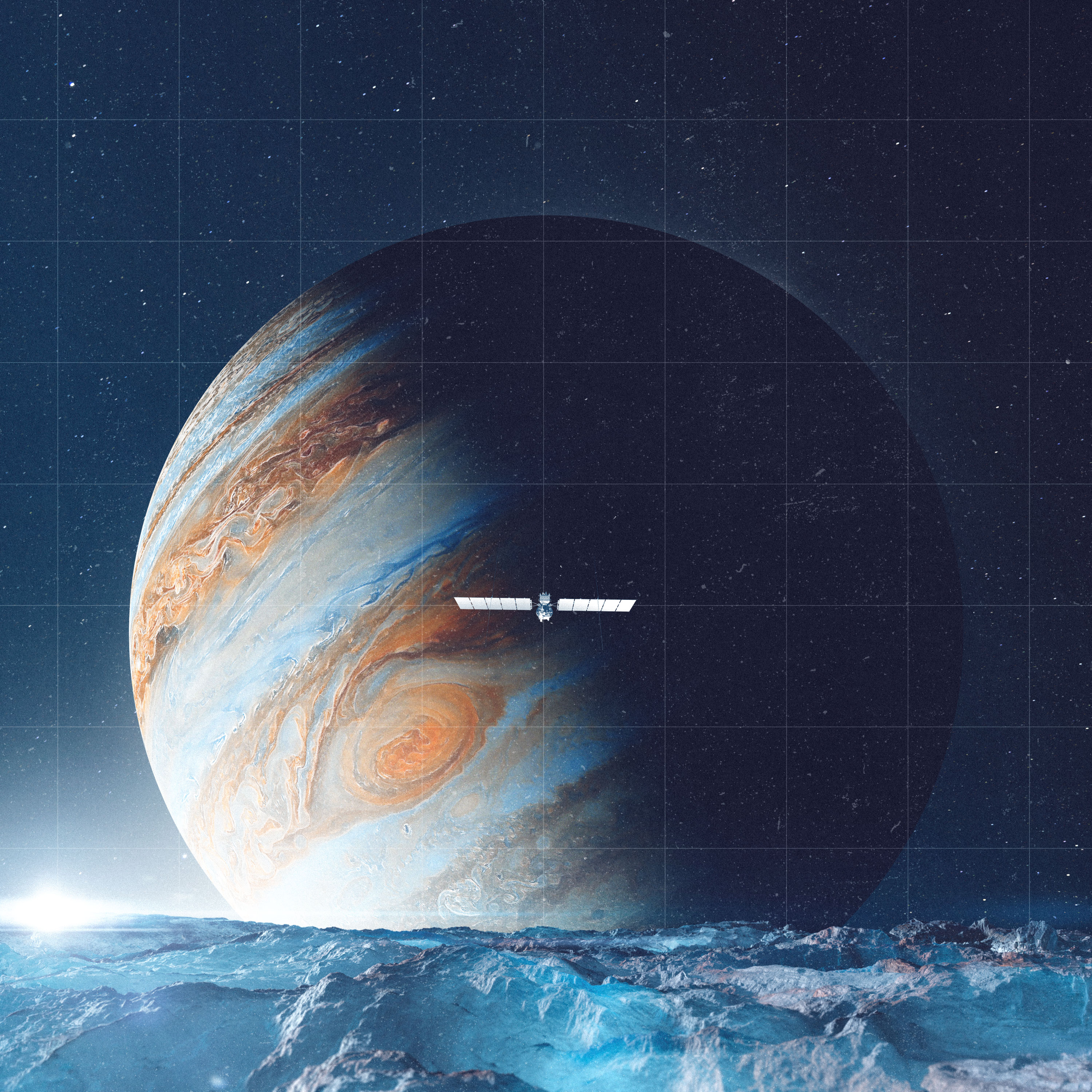
NASA+ Documentary Captures Europa Clipper’s Journey Into Deep Space
NASA invites the world behind the scenes to witness the story of Europa Clipper’s journey from a far-off vision to a cutting-edge deep space exploration mission with the release.
Key points
- Focus: NASA invites the world behind the scenes to witness the story of Europa Clipper’s journey from a far-off vision to a cutting-edge deep space
- Detail: separate announcement from evidence
- Editorial reading: institutional release, useful as a primary source but not independent validation.
NASA invites the world behind the scenes to witness the story of Europa Clipper’s journey from a far-off vision to a cutting-edge deep space exploration mission with the release of the agency’s newest documentary, “The Europa Concept. The institutional report frames the development in practical terms and ties it to the broader mission or observing effort.
It is relevant because astronomy does not advance on single detections. The field builds confidence by accumulating independent observations across different wavelengths, instruments and epochs until isolated signals become defensible conclusions. What looks convincing in one dataset can dissolve when a second instrument looks at the same target, and what looks marginal can solidify when follow-up campaigns confirm the original reading. The current standard requires that a result survive this triangulation before the community treats it as settled. Find “The Europa Concept” on NASA+ here: https: //plus. nasa. gov/video/the-europa-concept/ More about Europa Clipper Managed by Caltech in Pasadena, California, JPL leads the. 818-354-8307 matthew. j. segal@jpl. nasa. gov Written by Kristy Hutchings 2026-086 Share Details Last Updated Nov 23, 2026 Related Terms Europa Clipper Europa.
NASA/JPL-Caltech NASA invites the world behind the scenes to witness the story of Europa Clipper’s journey from a far-off vision to a cutting-edge deep space exploration mission. It took decades of science, thousands of dedicated minds, endless creativity, and a whole lot of grit to get the Europa Clipper spacecraft to the launch pad in 2024.
Now the orbiter, the largest NASA has ever sent into deep space, is two years into its five-year, 1.8 billion-mile (2. The things we will learn from Europa Clipper will be so sensational, so fantastic, that everyone will be screaming for the next mission,” said Curt Niebur, program scientist in.
The moon, an object of fascination since its discovery by Galileo Galilei in 1610, only began to reveal its secrets with data obtained by NASA’s Pioneer 10 in 1973, followed the. More detailed glimpses of the moon followed from the agency’s Voyager 2, Galileo, Cassini, and Juno missions, each helping illuminate the way for Europa Clipper.
What gives the story weight is not just the object itself, but the way the measurement trims the range of plausible physical explanations. Astronomy has accumulated enough cases to know that the most interesting results are rarely the ones that confirm expectations cleanly; they are the ones that confirm some expectations while complicating others, or that open a parameter space that previous instruments could not reach. The scientific community evaluates these contributions by asking whether the new data constrain a model in a way that older data could not, and whether those constraints survive systematic review.
Work officially began on the mission at NASA’s Jet Propulsion Laboratory in Southern California in 2013, initiating an 11-year trek to build the spacecraft and its suite of nine. 14, 2024, a Category 5 hurricane and tornadoes near NASA’s Kennedy Space Center in Florida.
Because the account originates with NASA News Releases, it functions best as a primary institutional report that is close to the data and operations, not as independent scientific validation. Institutional communications are produced by organizations with legitimate interests in presenting their work in a favorable light, which does not make them unreliable but does make them partial. Details that complicate the narrative, including instrument limitations, unexpected failures and results below projections, tend to be minimized relative to progress messages. Technical documentation and peer-reviewed publications, where they exist, provide the complementary layer that institutional releases cannot substitute.
The next step is to see whether other instruments and other wavelengths tell the same story. Campaigns with JWST, the VLT, the forthcoming Extremely Large Telescopes and radio arrays will provide the spectral coverage and spatial resolution needed to move from detection to physical characterization. The timeline for that kind of confirmation is typically measured in years, not months, which is worth keeping in mind when reading the current result.
Original source: NASA News Releases