LISA's Gravitational Wave Detections Could Reveal Exoplanets
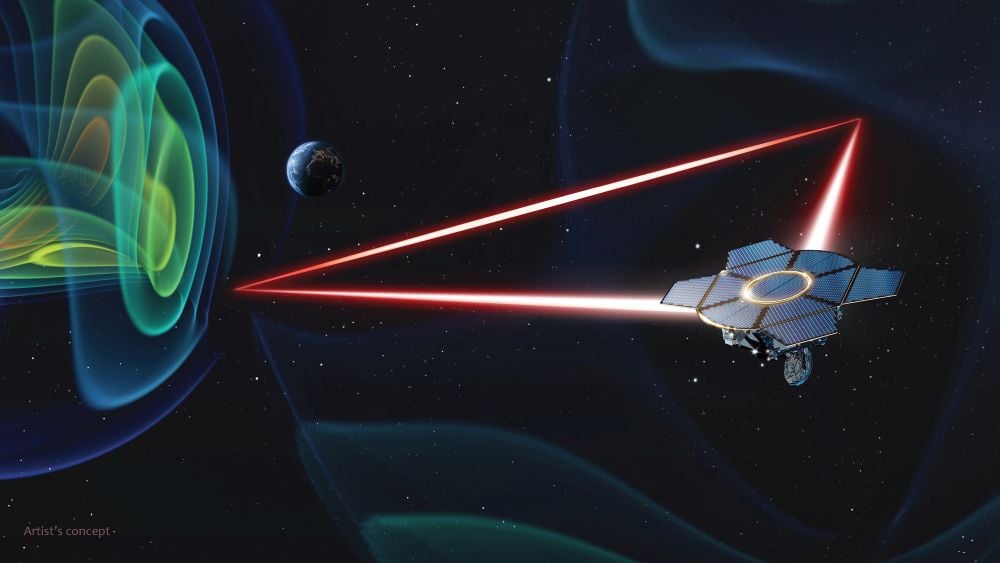
LISA, the ESA's Laser Interferometry Space Antenna, is being built to detect gravitational waves emitted when massive objects spiral together and merge.
Key points
- Focus: LISA, the ESA's Laser Interferometry Space Antenna, is being built to detect gravitational waves emitted when massive objects spiral together and
- Detail: Science reporting: verify primary technical documentation
- Editorial reading: science reporting; whenever possible, verify the cited primary source.
LISA, the ESA's Laser Interferometry Space Antenna, is being built to detect gravitational waves emitted when massive objects spiral together and merge. The science-journalism coverage adds useful context, while the strongest evidential footing still comes from the underlying data, papers or institutional documentation.
The significance lies in exoplanet science has moved beyond the era of simple discovery into a period of comparative characterization. With more than five thousand confirmed planets known, the scientifically productive questions now concern atmospheric composition, internal structure, orbital history and the statistical properties of populations rather than the existence of individual worlds. A new detection or spectral measurement is most valuable when it adds a well-constrained data point to those comparative frameworks, not when it stands alone as an anecdote. The ESA is still developing the mission, but it's basic design is established. And the Universe was opaque to light in its first 380, 000 years, so that time period is behind a curtain.
He's the sole author of " Receiving Exoplanet Messages with Gravitational-wave Carriers: The Gravitational-wave Radial Velocity Method," published in The Astrophysical Journal. So detecting them also clarifies the GW signal from the compact binary.
It explains how the JWST can confirm GW exoplanet detections, possibly with help from Gaia or the Habitable Worlds Observatory. By themselves, double white dwarfs will emit gravitational waves at a nearly continuous frequency," said Scott Noble, a theoretical astrophysicist at NASA Goddard and a coauthor.
Add a sufficiently massive planet to the system, and its presence causes the binary to experience reflex motion, adding a Doppler modulation to the gravitational signal. DWDs are rarer than single WDs, but astronomers still think that there are about 10 million DWDs with orbital periods of less than one hour in the Milky Way.
The broader interest lies in making the target less anecdotal and more comparable with the rest of the known planetary population. Population-level questions, such as the frequency of atmospheres around small rocky planets or the prevalence of water-rich worlds in the habitable zone, require well-characterized individual data points before statistical patterns become meaningful. Each new planet with a measured radius, mass and, ideally, atmospheric constraint is a brick in that larger structure, and the accumulation of bricks eventually allows theorists to test formation models against real distributions rather than projections.
In their work, they use a representive known DWD (ZTF J2243+5242) to compute its detectability by LISA GWRV. We then demonstrate two complementary EM techniques, JWST infrared (IR) excess and Gaia or Habitable Worlds Observatory astrometry, that could independently confirm a GW-detected.
Because this item comes through Universe Today as science journalism, it should be treated as contextual reporting rather than primary evidence. Good science reporting can identify why a result matters, connect it to the wider literature and make technical work readable, but the decisive evidence remains in the original paper, dataset, mission release or technical record. That distinction is especially important when a story is later repeated by aggregators, because repetition increases visibility, not evidential strength.
The next step is to improve independent constraints on the mass, radius, atmospheric composition and orbital dynamics of the target. Transmission spectroscopy with JWST, radial velocity campaigns with high-resolution ground-based spectrographs and phase-curve measurements from space photometry represent the observational toolkit that can move characterization from plausible to robust. That convergence of techniques is the standard the community now expects before a planetary atmosphere result is treated as confirmed.
Original source: Universe Today