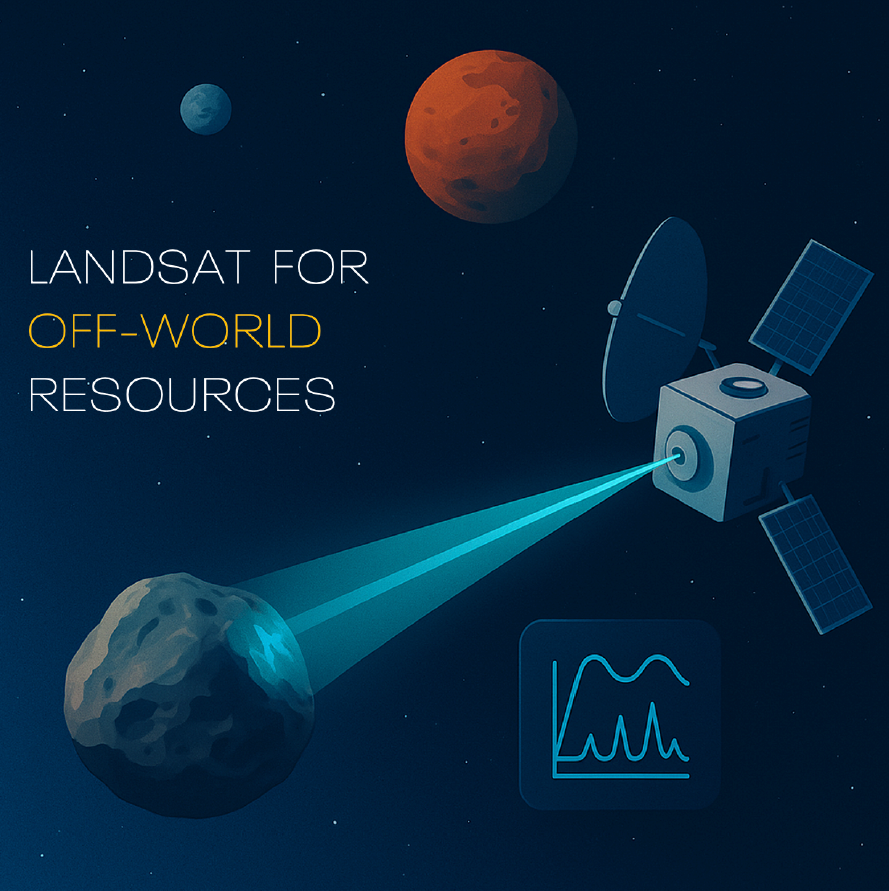
Interworld Slingshot Resource Surveys
Pablo Sobron SanchezSETI Institute This proposal explores a new class of reconnaissance spacecraft that map minerals from orbit using Raman spectroscopy during high-speed flybys.
Key points
- Focus: Pablo Sobron SanchezSETI Institute This proposal explores a new class of reconnaissance spacecraft that map minerals from orbit using Raman
- Detail: separate announcement from evidence
- Editorial reading: institutional release, useful as a primary source but not independent validation.
Pablo Sobron SanchezSETI Institute This proposal explores a new class of reconnaissance spacecraft that map minerals from orbit using Raman spectroscopy during high-speed flybys, without landing, sample return, or extended dwell. The institutional report frames the development in practical terms and ties it to the broader mission or observing effort.
The significance lies in chemistry gains force when a claimed structure or process can be described with enough precision to be reproduced by others. Synthetic routes, spectroscopic signatures, yield under defined conditions and stability under realistic operating parameters are the currency of credibility in chemistry, and a result that lacks these details cannot be evaluated independently. The distance between a discovery on a laboratory bench and a process that works reliably at scale is measured in years of optimization, and each step reveals constraints that were invisible at smaller scale. If feasible, this concept would enable NASA to evaluate ice and ilmenite at the Moon, ore content at asteroids, and volatile-bearing minerals at Mars’ moons, all with a single. Performing Raman from 30, 50 km standoff would open a new regime for planetary science and space resource mapping, delivering the compositional specificity that passive.
The reference mission concept uses a single solar electric propulsion spacecraft to conduct three reconnaissance legs: (1) 50 km polar orbit of the Moon to map ice and ilmenite. (2) a 30 km flyby of a near-Earth asteroid to identify silicates, metals, and organics.
(3) a 30, 50 km orbit of Phobos or Deimos to detect volatile-rich phases that inform Mars mission logistics. To determine feasibility, this NIAC Phase I study answers three core questions: (1) Can key mineral Raman lines be detected with adequate signal-to-noise from 50 km.
(3) Can a 300-kg spacecraft with realistic propulsion, power, and attitude control systems close the mission architecture across all three destinations. Methods include first-principles photon modeling based on known Raman cross-sections, spacecraft jitter analysis, and trajectory design using NASA’s standard mission planning.
The broader interest lies in whether the claimed property or reaction pathway can be characterized with enough precision to support replication by other groups. Chemistry has a replication problem that is less discussed than the one in psychology or medicine, but it is real: synthetic procedures that work reliably in one laboratory sometimes fail to transfer, for reasons ranging from impure starting materials to undocumented temperature sensitivities. A result that comes with full experimental detail and a clear characterization of the product is far more valuable than one that reports a discovery without the procedural backbone.
PI Sobron led field 120-meter-range Raman systems and contributed to SuperCam and SHERLOC on Mars. Co-I Lee and Collaborator Yu from NASA Goddard bring direct heritage from ICESat-2 and other orbital laser systems.
Because the account originates with NASA News Releases, it functions best as a primary institutional report that is close to the data and operations, not as independent scientific validation. Institutional communications are produced by organizations with legitimate interests in presenting their work in a favorable light, which does not make them unreliable but does make them partial. Details that complicate the narrative, including instrument limitations, unexpected failures and results below projections, tend to be minimized relative to progress messages. Technical documentation and peer-reviewed publications, where they exist, provide the complementary layer that institutional releases cannot substitute.
The next step is to see whether independent groups working with orthogonal techniques reach compatible conclusions, and whether the result scales beyond the conditions used in the original study. Chemical discoveries that matter tend to be ones whose key properties can be measured by multiple spectroscopic, crystallographic or computational methods that are unlikely to share the same blind spots. Scalability, cost and long-term stability under realistic operating conditions are additional filters that come into play before any practical application becomes viable.
Original source: NASA News Releases