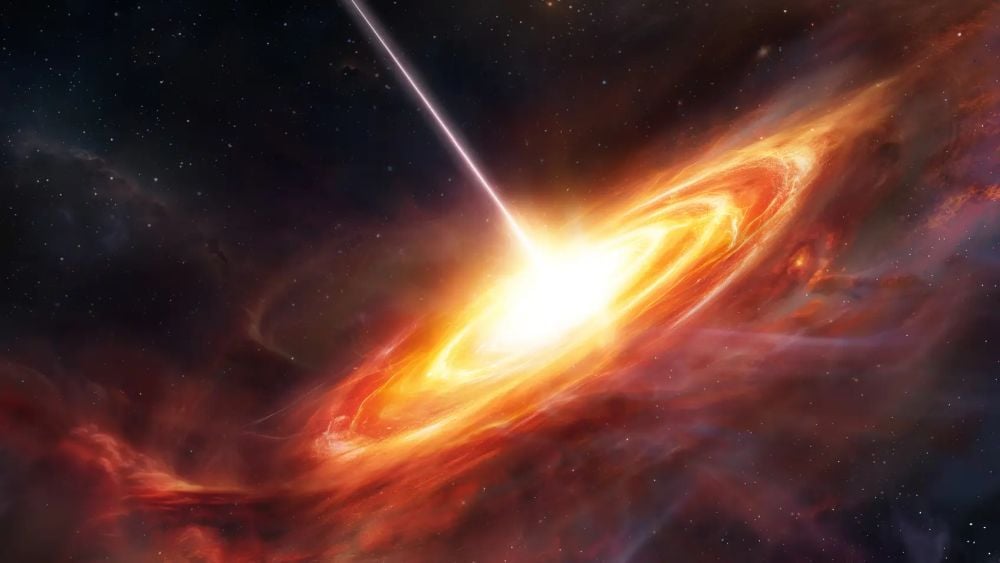
Euclid's Record-Setting Quasar Probes Black Hole Formation
This matters because astrophysics becomes persuasive only when an observed signal can be tied to a physically defensible explanation.
Key points
- Focus: The ESA's Euclid Space Telescope has found a record-setting quasar
- Detail: Science reporting: verify primary technical documentation
- Editorial reading: science reporting; whenever possible, verify the cited primary source.
The ESA's Euclid Space Telescope has found a record-setting quasar. Euclid found it at redshift z=8.13, corresponding to about 630 million years after the Big Bang. It beats the record by about 40 million years. The science-journalism coverage adds useful context, while the strongest evidential footing still comes from the underlying data, papers or institutional documentation.
This matters because astrophysics becomes persuasive only when an observed signal can be tied to a physically defensible explanation. Compact objects such as neutron stars and black holes are natural laboratories for extreme physics, but the distance and complexity of these systems make interpretation difficult without multi-wavelength coverage and careful modeling. A detection without a mechanism is only half a result. the other half comes from showing that the signal fits quantitatively inside a coherent physical picture rather than merely being consistent with a broad family of models. Euclid found it at redshift z=8.13, corresponding to about 630 million years after the Big Bang. The ESA's Euclid just found the newest record holder: the telescope observed it 40 million years sooner than the previous record-holder, and it was found at redshift z=8.
The quasar's technical name is J1504+6252, but it's been given the more recognizable name Dún Aonghasa. The discovery is in research published in Astronomy and Astrophysics titled " Euclid: Discovery of a quasar at z = 8.13 hosting a 360-million-solar-mass black hole.
A big part of that job is measuring galaxies at different redshifts in its Euclid Wide Survey, to see how their morphologies are different over time. Euclid found Dún Aonghasa in its Euclid Wide Survey imaging, but didn't confirm it.
Follow-up observations by Keck, the Hubble, the Large Binocular Telescope, and especially the JWST provided the confirmation. JWST spectroscopy let the researchers measure "a systemic redshift of z sys = 8.129 ± 0.005, corresponding to only 630 Myr after the Big Bang and shifting the quasar redshift.
The broader interest lies in turning an observational clue into something that can be weighed against competing models of the underlying physics. Astrophysics does not have the luxury of controlled experiments; everything is inferred from radiation that traveled across cosmic distances under conditions that cannot be reproduced in a terrestrial laboratory. This makes the interpretation chain longer and more uncertain than in bench science, but it also means that a well-constrained measurement of an extreme object carries theoretical information that no earthbound experiment can provide.
Its luminosity helped researchers measure its mass and its accretion rate, and Dún Aonghasa contains 360 million solar masses. This highlights how quickly Euclid is expanding our census of the most distant quasars.
Because this item comes through Universe Today as science journalism, it should be treated as contextual reporting rather than primary evidence. Good science reporting can identify why a result matters, connect it to the wider literature and make technical work readable, but the decisive evidence remains in the original paper, dataset, mission release or technical record. That distinction is especially important when a story is later repeated by aggregators, because repetition increases visibility, not evidential strength.
The next step is to see whether independent datasets and physical modeling converge on the same interpretation. Multi-wavelength follow-up, combining X-ray, radio and optical data where possible, is typically what separates a compelling detection from a robust physical characterization. In high-energy astrophysics, results that initially looked definitive have been revised when data from a second messenger arrived; the current result should be read with that history in mind.



Original source: Universe Today