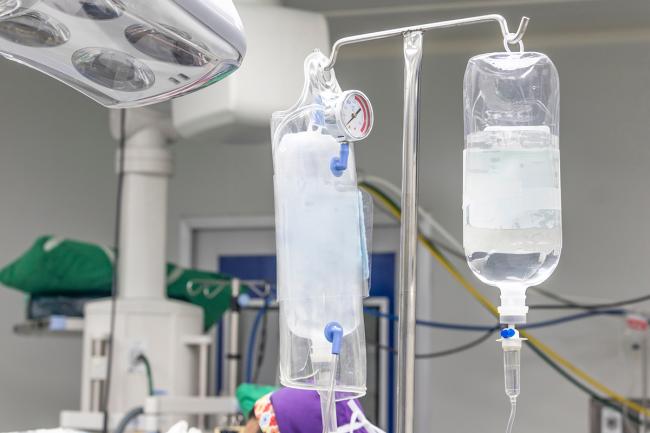
Clinical trial finds no difference in fluid treatment options for pediatric sepsis
NIH-supported study is largest ever to compare fluid interventions to prevent major kidney damage in children treated for septic shock.
Key points
- Focus: NIH-supported study is largest ever to compare fluid interventions to prevent major kidney damage in children treated for septic shock
- Detail: Institutional origin: separate announcement from evidence
- Editorial reading: institutional release, useful as a primary source but not independent validation.
NIH-supported study is largest ever to compare fluid interventions to prevent major kidney damage in children treated for septic shock. The institutional report frames the development in practical terms and ties it to the broader mission or observing effort.
This matters because biology becomes more informative when an observed effect begins to look like a mechanism rather than an isolated pattern. The gap between identifying a correlation in biological data and understanding the causal chain that produces it is routinely underestimated, and the history of biomedical research is populated with associations that collapsed when the mechanism was sought and not found. A result that comes with a proposed mechanism, even a partial one, is more useful than a purely descriptive finding because it generates testable predictions that can narrow the hypothesis space. The trial, which enrolled over 9, 000 participants across five countries, sought to answer a longstanding question about which intravenous crystalloid fluid type was the superior. For decades, pediatricians have debated which is the best intravenous resuscitation treatment for children with severe infections who have suspected septic shock,” said Rohan.
They assigned over 4, 200 participants between the ages of 2 months and 17 years into each arm of the trial and found no significant differences between the groups for incidences. Participants in both groups received their assigned IV fluid type for 24-48 hours and achieved a median of 23 hospital-free days during the 28 days following enrollment.
Children receiving the 0.9% saline solution had significantly higher incidences of abnormally high levels of chloride and sodium in their blood, while those receiving the balanced. Because the study targeted children with community-acquired sepsis who presented to an emergency department in high-resource locations, the authors are uncertain if these results.
New Zealand, and Costa Rica. For more information, visit https: //www. nichd. nih. gov.
The broader interest lies in whether the reported effect points toward a real mechanism and not merely a reproducible but unexplained association. Biology has learned from decades of biomarker failures that correlation, even robust correlation, is not a substitute for mechanistic understanding. A pathway that can be traced from molecular interaction to cellular response to organismal phenotype provides a far stronger foundation for intervention than a statistical association discovered in a large dataset, however well the statistics are done.
NIH is the primary federal agency conducting and supporting basic, clinical, and translational medical research, and is investigating the causes, treatments, and cures for both. For more information about NIH and its programs, visit www. nih. gov.
Because the account originates with NIH News Releases, it functions best as a primary institutional report that is close to the data and operations, not as independent scientific validation. Institutional communications are produced by organizations with legitimate interests in presenting their work in a favorable light, which does not make them unreliable but does make them partial. Details that complicate the narrative, including instrument limitations, unexpected failures and results below projections, tend to be minimized relative to progress messages. Technical documentation and peer-reviewed publications, where they exist, provide the complementary layer that institutional releases cannot substitute.
The next step is to test whether the effect repeats across different methods, cell types, model organisms and experimental conditions. Reproducibility is the first test, but mechanistic dissection is the second, and a result that passes both has a substantially better chance of translating into something clinically or biotechnologically useful. The path from a laboratory finding to an applied outcome typically takes a decade or more, and most findings do not complete it; the current result sits at the beginning of that process.
Original source: NIH News Releases