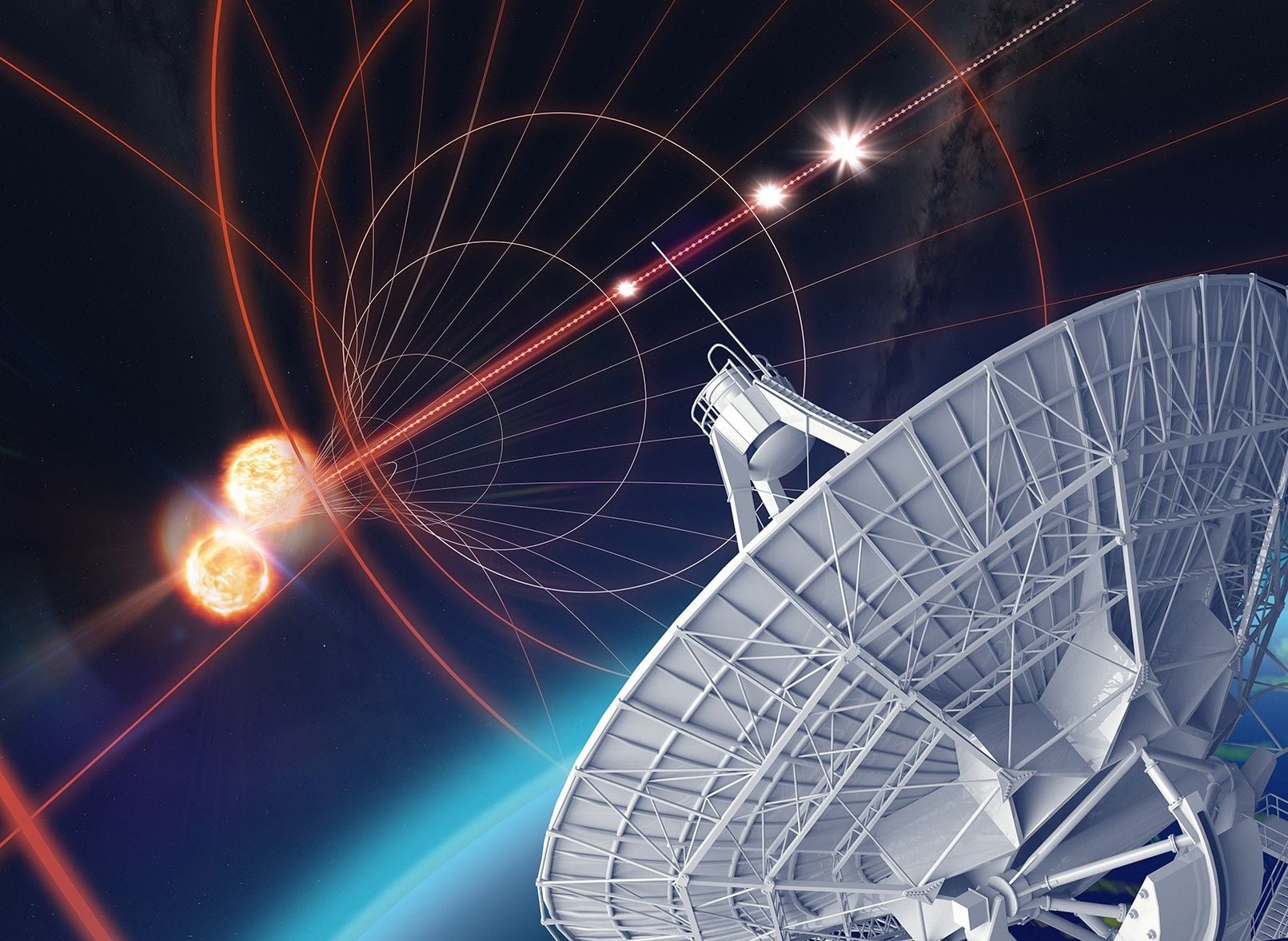
Astronomers Use a Neutron Star Merger to Measure Cosmic Expansion
Swinburne University of Technology and CSIRO have combined telescope and gravitational wave data in an attempt to unlock the true value of the Universe’s expansion.
Key points
- Focus: Swinburne University of Technology and CSIRO have combined telescope and gravitational wave data in an attempt to unlock the true value of the
- Detail: Science reporting: verify primary technical documentation
- Editorial reading: science reporting; whenever possible, verify the cited primary source.
Swinburne University of Technology and CSIRO have combined telescope and gravitational wave data in an attempt to unlock the true value of the Universe’s expansion. The science-journalism coverage adds useful context, while the strongest evidential footing still comes from the underlying data, papers or institutional documentation.
This matters because astrophysics becomes persuasive only when an observed signal can be tied to a physically defensible explanation. Compact objects such as neutron stars and black holes are natural laboratories for extreme physics, but the distance and complexity of these systems make interpretation difficult without multi-wavelength coverage and careful modeling. A detection without a mechanism is only half a result. the other half comes from showing that the signal fits quantitatively inside a coherent physical picture rather than merely being consistent with a broad family of models. Existing measurements of the Hubble Constant have split cosmologists for more than a decade. Known as the Hubble-Lemaitre Constant, in honor of the two astronomers who demonstrated it, this law is fundamental to our cosmological models.
In a recent study, an international team led by researchers at Swinburne University of Technology (SUT) and Australia's Commonwealth Scientific and Industrial Research. By combining telescope observations and gravitational wave data, they have produced new measurements of the Hubble-Lemaitre Constant.
The problem is that the measurements are in "tension" with one another, leading to an ongoing debate among cosmologists known as the Hubble Tension. To break it down, the first and second "rung" of the Ladder consists of using parallax measurements of nearby stars and "standard candles" (Cepheid Variables and Type Ia.
Thanks to the venerable *Hubble Space Telescope*, astronomers calculated an expansion rate of 252, 000 km/h (156, 585.5 mph) per megaparsec (Mpc) - roughly 3.262 million light-years. The mapping of this background by the ESA's Planck satellite yielded an estimate of about 244, 000 km/h per Mpc (or about 269 km/s per light-year).
The broader interest lies in turning an observational clue into something that can be weighed against competing models of the underlying physics. Astrophysics does not have the luxury of controlled experiments; everything is inferred from radiation that traveled across cosmic distances under conditions that cannot be reproduced in a terrestrial laboratory. This makes the interpretation chain longer and more uncertain than in bench science, but it also means that a well-constrained measurement of an extreme object carries theoretical information that no earthbound experiment can provide.
By combining data from the High Sensitivity Array (HSA), a global network of telescopes, astrometry data from Hubble, and gravitational-wave data, the Swinburne- and CSIRO-led. The new value obtained from these observations was not as precise as the more established measurements.
Because this item comes through Universe Today as science journalism, it should be treated as contextual reporting rather than primary evidence. Good science reporting can identify why a result matters, connect it to the wider literature and make technical work readable, but the decisive evidence remains in the original paper, dataset, mission release or technical record. That distinction is especially important when a story is later repeated by aggregators, because repetition increases visibility, not evidential strength.
The next step is to see whether independent datasets and physical modeling converge on the same interpretation. Multi-wavelength follow-up, combining X-ray, radio and optical data where possible, is typically what separates a compelling detection from a robust physical characterization. In high-energy astrophysics, results that initially looked definitive have been revised when data from a second messenger arrived; the current result should be read with that history in mind.

Original source: Universe Today