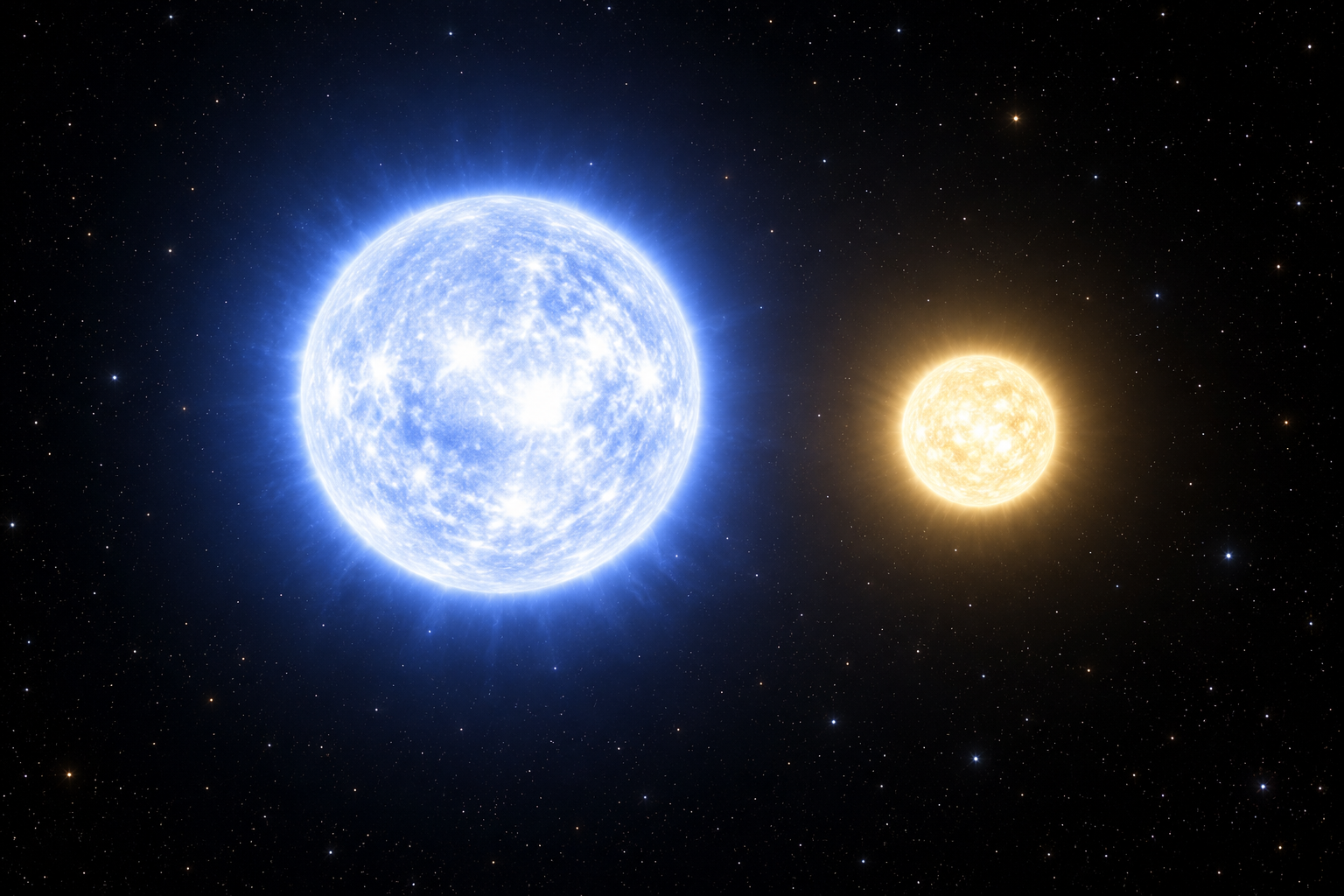
Astronomers Discover a Hidden Binary in a Star System Used to Calibrate the JWST
Researchers from the Xinjiang Astronomical Observatory of the Chinese Academy of Sciences have discovered a binary system in a field used to calibrate the JWST's optics.
Key points
- Focus: Researchers from the Xinjiang Astronomical Observatory of the Chinese Academy of Sciences have discovered a binary system in a field used to
- Detail: Science reporting: verify primary technical documentation
- Editorial reading: science reporting; whenever possible, verify the cited primary source.
Researchers from the Xinjiang Astronomical Observatory of the Chinese Academy of Sciences have discovered a binary system in a field used to calibrate the JWST's optics. The science-journalism coverage adds useful context, while the strongest evidential footing still comes from the underlying data, papers or institutional documentation.
It is relevant because astronomy does not advance on single detections. The field builds confidence by accumulating independent observations across different wavelengths, instruments and epochs until isolated signals become defensible conclusions. What looks convincing in one dataset can dissolve when a second instrument looks at the same target, and what looks marginal can solidify when follow-up campaigns confirm the original reading. The current standard requires that a result survive this triangulation before the community treats it as settled. When observatories like the James Webb Space Telescope (JWST) conduct observation campaigns, they often start by observing star fields to calibrate their instruments. In fact, a star that is used for JWST calibration (HD 158485), which was thought to be an A-type star, has been identified as a binary system.
The discovery was made by a team from the Xinjiang Astronomical Observatory of the Chinese Academy of Sciences (CAS), who found the binary while reviewing long-term observations. HD 158485 is an example of a pulsating, variable, or Delta (δ) Scuti star, which experiences brightness changes at a regular frequency (typically every 18 minutes to 8 hours) From.
They further noticed that these pulses fell into two groups with opposing light-travel-time variations, meaning that the light from these pulses reached Earth at different times. The team used the variation between the two signals to trace the star's orbital motion with HD 158485, which showed that they orbit each other every 382.8 days.
Pulsation timing results for HD 158485. Their findings are independently confirmed by an orbital model built from earlier TESS data, which accurately predicted the timing variations that were detected by a separate.
What gives the story weight is not just the object itself, but the way the measurement trims the range of plausible physical explanations. Astronomy has accumulated enough cases to know that the most interesting results are rarely the ones that confirm expectations cleanly; they are the ones that confirm some expectations while complicating others, or that open a parameter space that previous instruments could not reach. The scientific community evaluates these contributions by asking whether the new data constrain a model in a way that older data could not, and whether those constraints survive systematic review.
Matt Williams is a space journalist, science communicator, and author with several published titles and studies. His work is featured in The Ross 248 Project and Interstellar Travel edited by NASA alumni Les Johnson and Ken Roy.
Because this item comes through Universe Today as science journalism, it should be treated as contextual reporting rather than primary evidence. Good science reporting can identify why a result matters, connect it to the wider literature and make technical work readable, but the decisive evidence remains in the original paper, dataset, mission release or technical record. That distinction is especially important when a story is later repeated by aggregators, because repetition increases visibility, not evidential strength.
The next step is to see whether other instruments and other wavelengths tell the same story. Campaigns with JWST, the VLT, the forthcoming Extremely Large Telescopes and radio arrays will provide the spectral coverage and spatial resolution needed to move from detection to physical characterization. The timeline for that kind of confirmation is typically measured in years, not months, which is worth keeping in mind when reading the current result.

Original source: Universe Today