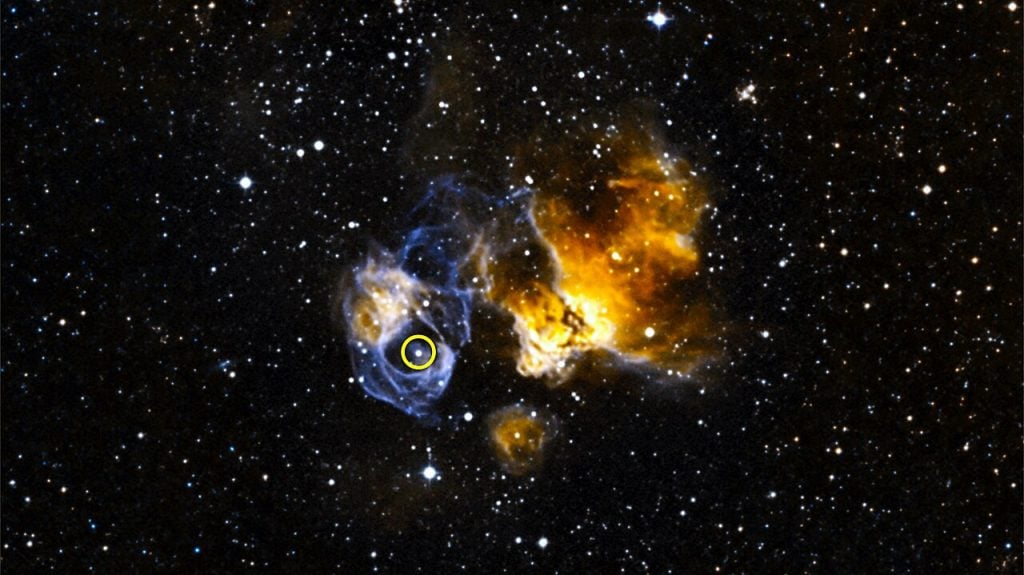
ALMA Reveals a Jet of Cool Gas from a Microquasar
There's a strange gamma-ray emitter in the Large Magellanic Cloud that has astronomers stumped about its source.
Key points
- Focus: There's a strange gamma-ray emitter in the Large Magellanic Cloud that has astronomers stumped about its source
- Detail: Science reporting: verify primary technical documentation
- Editorial reading: science reporting; whenever possible, verify the cited primary source.
There's a strange gamma-ray emitter in the Large Magellanic Cloud that has astronomers stumped about its source. It lies within the ashes left behind by a supernova that created a compact object that's part of the system. The science-journalism coverage adds useful context, while the strongest evidential footing still comes from the underlying data, papers or institutional documentation.
That matters because astrophysics becomes persuasive only when an observed signal can be tied to a physically defensible explanation. Compact objects such as neutron stars and black holes are natural laboratories for extreme physics, but the distance and complexity of these systems make interpretation difficult without multi-wavelength coverage and careful modeling. A detection without a mechanism is only half a result. the other half comes from showing that the signal fits quantitatively inside a coherent physical picture rather than merely being consistent with a broad family of models. So, a research team from two Japanese universities decided to give the object, called LMC P3, a closer look. ALMA focused on radio emissions from carbon monoxide (CO) molecules in proximity to the cold cloud in the area around LMC P3.
According to astronomer Yasuo Fukui of Nagoya University, who worked with team leader Bhuvana Gadikere Rajendra of Gifu University, what they detected at LMC P3 is unusual. For reference, the bright star Vega lies 25 light-years away from us, so the jet would connect us and that star quite easily.
The strange thing is, the molecular jet itself is cold (by our standards), but astrophysically "heated" to a temperature of about 35 to 60 Kelvin. Fukui said the relatively high temperature observed over a large fraction of the molecular cloud makes it a very strong case that the gas is interacting with a high-energy jet.
Since black holes drive more powerful jets than neutron stars, the fact that LMC P3’s gamma-ray emission is particularly high is a smoking gun pointing toward the micro-quasar. Object LMC P3 was first discovered in 2016 thanks to its very strong gamma-ray emissions.
The broader interest lies in turning an observational clue into something that can be weighed against competing models of the underlying physics. Astrophysics does not have the luxury of controlled experiments; everything is inferred from radiation that traveled across cosmic distances under conditions that cannot be reproduced in a terrestrial laboratory. This makes the interpretation chain longer and more uncertain than in bench science, but it also means that a well-constrained measurement of an extreme object carries theoretical information that no earthbound experiment can provide.
Then, the FERMI telescope observed it and found a 10.3-day period in gamma-ray emissions from the object. These results provide strong evidence that CO jets are a signature sculpted by microquasar jets, lending support for mass accretion in LMC P3 as the gamma-ray origin.
Because this item comes through Universe Today as science journalism, it should be treated as contextual reporting rather than primary evidence. Good science reporting can identify why a result matters, connect it to the wider literature and make technical work readable, but the decisive evidence remains in the original paper, dataset, mission release or technical record. That distinction is especially important when a story is later repeated by aggregators, because repetition increases visibility, not evidential strength.
The next step is to see whether independent datasets and physical modeling converge on the same interpretation. Multi-wavelength follow-up, combining X-ray, radio and optical data where possible, is typically what separates a compelling detection from a robust physical characterization. In high-energy astrophysics, results that initially looked definitive have been revised when data from a second messenger arrived; the current result should be read with that history in mind.

Original source: Universe Today