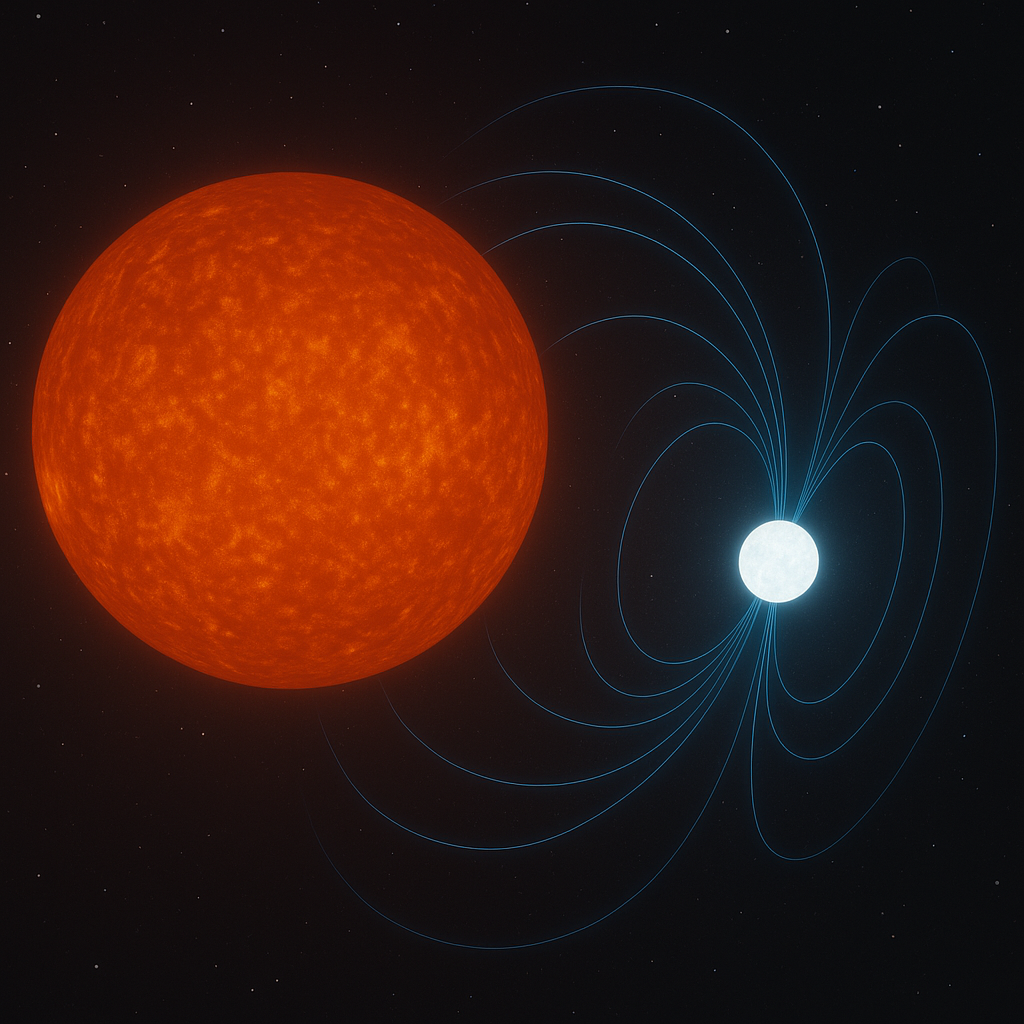
White Dwarf-Red Dwarf Binaries Power Cosmic Lasers
Researchers have helped unravel the mystery of why certain pairs of stars pulse with regular, long-period bursts of radio waves.
Pontos-chave
- Em foco: Researchers have helped unravel the mystery of why certain pairs of stars pulse with regular, long-period bursts of radio waves
- Detalhe: Cobertura jornalística: verificar documentação técnica primária
- Leitura editorial: reportagem científica; quando possível, confira a fonte primária citada.
Researchers have helped unravel the mystery of why certain pairs of stars pulse with regular, long-period bursts of radio waves. The particular class of objects they observed come in pairs that always include a compact dead star, called a white dwarf, locked in orbit with an M dwarf, a red star smaller than our Sun.
In a new study, Caltech researchers used supercomputer simulations that have (for the first time) provided a clear picture of how interactions between these binary pairs power the masers they shoot into space. Their results, published in The Astrophysical Journal Letters, offer scientists a new method for creating computational models of radio emission from binary systems with an interacting white dwarf.
Most, two researchers from the Theoretical AstroPhysics Including Relativity and Cosmology (TAPIR) group and the Walter Burke Institute for Theoretical Physics at the California Institute of Technology (Caltech). Credit: AI-generated artwork by Elias Most Interestingly, radio pulses observed in white dwarf-M-type dwarf (WD-MD) systems resemble the planetary radio emissions observed between Jupiter and its innermost "Galilean" moon Io.
Astronomers first noted these radio bursts in 1955 and were puzzled as to what mechanisms could be driving them. This prediction was later confirmed by direct satellite imaging, while other research demonstrated how these currents power the radio waves.
In their study, Zhong and Most examined how this same mechanism could power radio bursts in two known WD-MD systems: GLEAM-X J0704, 37 and ILT J1101+5521. The former system was previously confirmed by Caltech researcher Antonio Rodriguez (PhD '25) to be powered by ECMI.
The results confirm that Peter Goldreich's and Donald Lynden-Bell's theory about Jupiter and Io is applicable beyond planets in our solar system.



Fonte original: Universe Today