This Supernova is 50 Million Light Years Away, But That's Close Enough For Astronomers
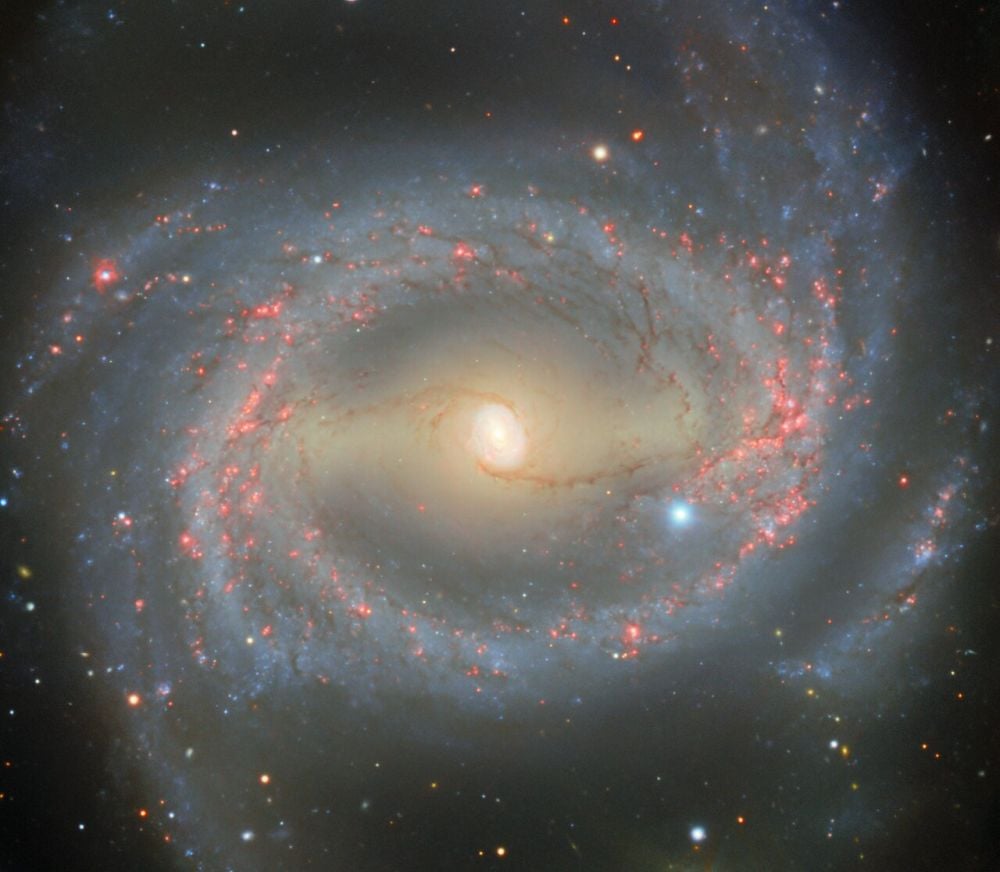
A new supernova has been detected in a spiral galaxy about 50 million light years away. That's close enough for detatiled follow-up observations, which have already begun.
Pontos-chave
- Em foco: A new supernova has been detected in a spiral galaxy about 50 million light years away
- Detalhe: Cobertura jornalística: verificar documentação técnica primária
- Leitura editorial: reportagem científica; quando possível, confira a fonte primária citada.
A new supernova has been detected in a spiral galaxy about 50 million light years away. That's close enough for detatiled follow-up observations, which have already begun.
A new supernova has been spotted in NGC 1433, a spiral galaxy about 50 million light years away. Material builds up on the surface of the white dwarf until it breaches the Chandrasekhar limit, about 1.44 solar masses.
But even though thousands of transients and supernovae have been found this year, this one is still particularly noteworthy for its relative proximity to Earth, and because it was detected early. ATLAS is designed and optimized to detect incoming near-Earth Objects shortly before they reach Earth, but it can also detect other transients.
The AstroNotes for SN 2026ahvu reads: "ATLAS operates with 4 x 0.5m telescopes in Hawaii (Haleakala and Mauna Loa), Chile (El Sauce) and South Africa (Sutherland), and a fifth unit in Tenerife, Canary Islands. We are robotically surveying the whole sky with a cadence of 1 day between -50 and +50 and 2 days in the polar regions, weather permitting.
While carrying out the primary mission for Near-Earth Objects, we search for and publicly report stationary transients to the IAU Transient Name Server. " "We report a new transient source, most likely a supernova in the galaxy NGC 1433. When it was first discovered, its apparent magnitude was 17.
In this case, there are new images of SN 2026ahvu from the Dark Energy Camera (DECam) and the Gemini South telescope.


Fonte original: Universe Today