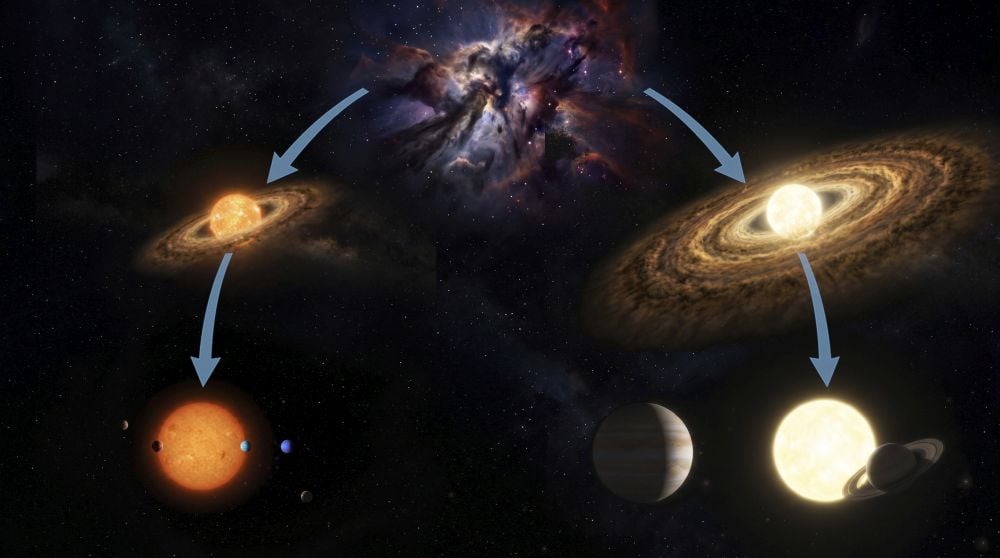
Host Stars Shape Their Planetary Systems Into Two Families
New research draws a link between a host star and the characteristics of its planetary system.
Pontos-chave
- Em foco: New research draws a link between a host star and the characteristics of its planetary system
- Detalhe: Cobertura jornalística: verificar documentação técnica primária
- Leitura editorial: reportagem científica; quando possível, confira a fonte primária citada.
New research draws a link between a host star and the characteristics of its planetary system. Higher mass stars create one family of systems, while lower mass stars create another.
The age of exoplanet science took shape with the Kepler mission, and gained more momentum with the TESS mission. Now exoplanet science is advancing beyond these initial stages.
In the 1990s, astronomers thought that our Solar System was a kind of template, where massive planets were further from their stars, while less massive ones were closer. The important 'peas-in-a-pod' idea was presented in a 2018 paper.
But a 2020 paper was particularly important, because it presented a way to compare how violent the dynamical histories of different solar systems is. The lead author of that important paper is also a co-lead author of new research that uses NAMD to establish a link between host star and solar system architecture.
The new research in Nature Astronomy builds on underlying ideas about host stars and how they shape their solar systems. It's titled " Two families of multi-planet systems with distinct architectures and stellar hosts," and has two co-first authors.
Explaining the origin of this striking diversity remains a central challenge for planet formation theory, compounded by observational biases that limit access to Solar System-like regimes.

Fonte original: Universe Today