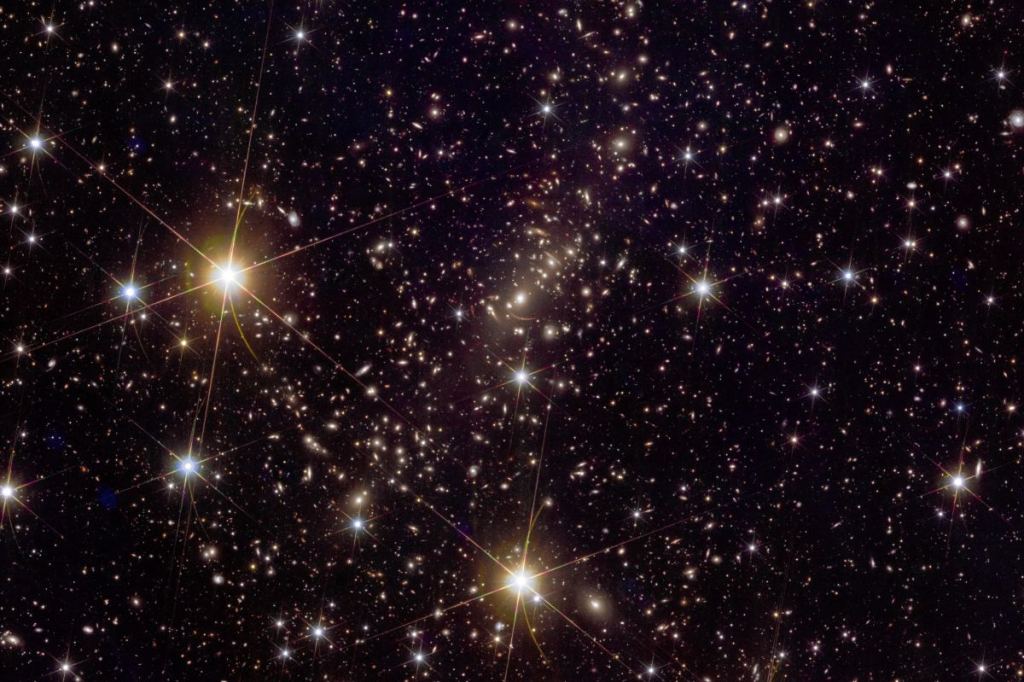
Euclid's Hunt for Strong Gravitational Lenses is Off to a Strong Start
Euclid was launched to build a 3D map of the sky to probe cosmic structure and the Universe's expansion.
Pontos-chave
- Em foco: Euclid was launched to build a 3D map of the sky to probe cosmic structure and the Universe's expansion
- Detalhe: Cobertura jornalística: verificar documentação técnica primária
- Leitura editorial: reportagem científica; quando possível, confira a fonte primária citada.
Euclid was launched to build a 3D map of the sky to probe cosmic structure and the Universe's expansion. Part of its job is to hunt for strong gravitational lenses, important probes of dark matter.
It found 15, 000 strong gravitational lens candidates in its first data relase. Euclid’s data gives us the potential to answer those questions. ” Euclid launched in July 2023 and orbits the Sun-Earth Lagrange point 2 (L2), roughly 1.5 million kilometers away from Earth, a popular spot for space telescopes.
Euclid delivered its first data release on November 12th, called DR-1 Foundation, and it holds a whopping 1.7 million gigabytes of data. Euclid also found 15, 000 new strong gravitational lens candidates, a massive increase in the potential number.
Strong lenses have been difficult to find, the odds were about one in 10, 000,” said Hrishabh Srivastava, doctoral student in the UBC department of physics and astronomy (PHAS). Before Euclid, we had less than a thousand confirmed strong lenses.
Now we have 15, 000 new candidates. ” Overall, Euclid is expected to find more than 100, 000 strong lenses over the course of its nominal six year mission. I like to call these gravitational lenses ‘nature's own magnifying glasses’ to probe the dark matter distribution of our universe,” said Srivastava.
So Euclid's 3D map can test both facets of Lambda-CDM: dark matter and dark energy.

Fonte original: Universe Today