Computer Simulations Provide the Best Explanation for Those "Little Red Dots" Yet!
Tiny ‘Little Red Dot’ galaxies found by the James Webb Space Telescope are revealed to be the remnants of supermassive primordial stars surrounded by dense gaseous envelopes.
Pontos-chave
- Em foco: Tiny ‘Little Red Dot’ galaxies found by the James Webb Space Telescope are revealed to be the remnants of supermassive primordial stars surrounded by
- Detalhe: Cobertura jornalística: verificar documentação técnica primária
- Leitura editorial: reportagem científica; quando possível, confira a fonte primária citada.
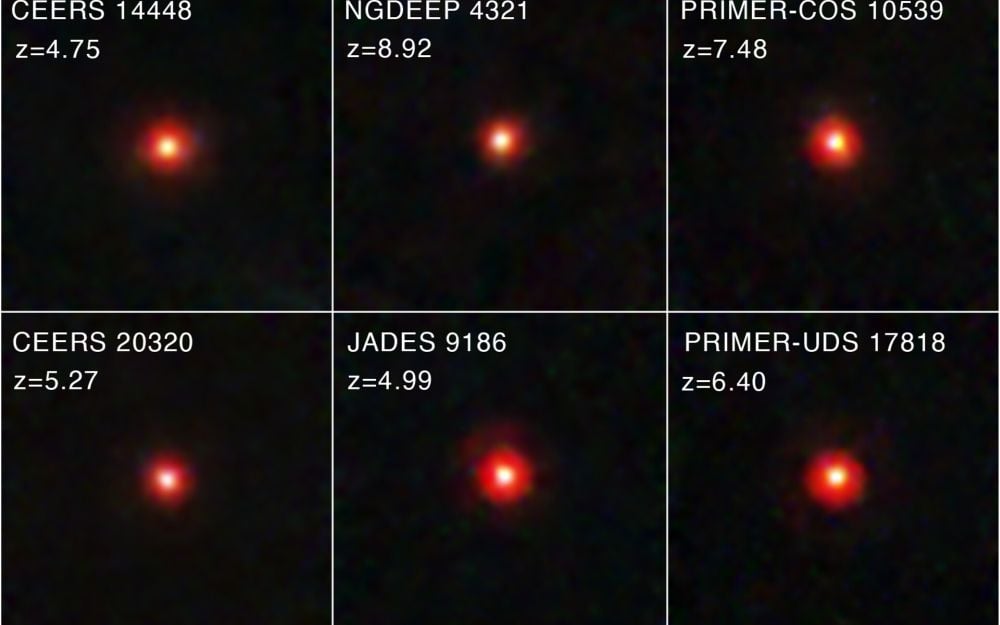
Tiny ‘Little Red Dot’ galaxies found by the James Webb Space Telescope are revealed to be the remnants of supermassive primordial stars surrounded by dense gaseous envelopes. When the James Webb Space Telescope (JWST) made its famous observations of several deep fields in the cosmos, astronomers were surprised to see numerous galaxies that defied expectations.
Credit: NASA/ESA/CSA/ISTA)/ETH Zurich/NAOJ Previous attempts to explain the rapid formation, abundance, and spectral characteristics of LRDs all suffered from the same issue. While each explained some characteristics, none could account for everything the JWST revealed in its deep field surveys.
This raises additional problems, including the self-shielding nature of molecular hydrogen. They are compact, only a few hundred light-years across, but are as bright as much larger galaxies, and their unusual V-shaped spectra have defied the usual astrophysical explanations.
These gaseous envelopes trap high-energy X-rays while allowing some visible, ultraviolet, and infrared light to escape, which fits with the unusual light signatures detected by the JWST. The simulations also explain another long-standing mystery about LRDs: that a large cluster of stars in the disks of these small galaxies produces the blue part of the spectrum Webb observed.
These disks, according to the models, contain around 100 million stars densely packed into regions measuring only 500 light-years in diameter, matching what astronomers observed in LRDs. Based on the available data, the team further concludes the black holes at the center of these primordial galaxies are only about 10 million Solar masses.
This is a few orders of magnitude less than previous estimates, which indicated a maximum of 100 million Solar masses.

Fonte original: Universe Today