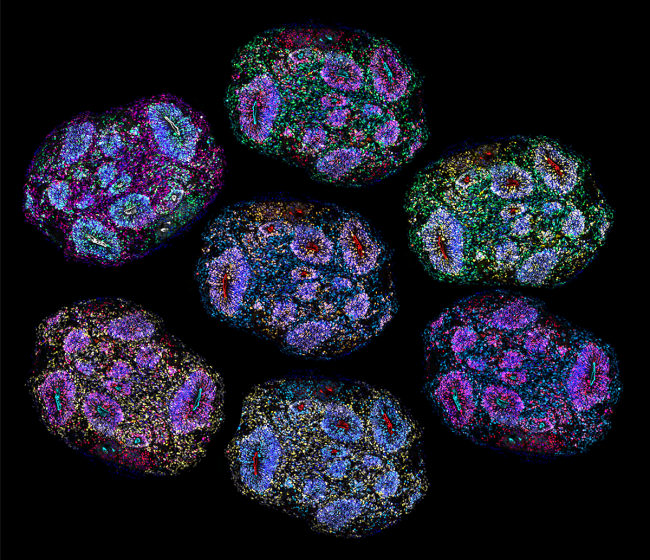
Brain organoid maturation is driven by a lifelike developmental clock
Researchers sustained the organoids for nearly six years, potentially unlocking longer term studies of neurodevelopmental disorders.
Pontos-chave
- Em foco: Researchers sustained the organoids for nearly six years, potentially unlocking longer term studies of neurodevelopmental disorders
- Detalhe: distinguir anúncio de evidência
- Leitura editorial: release institucional, útil como fonte primária, mas não como validação independente.
Researchers sustained the organoids for nearly six years, potentially unlocking longer term studies of neurodevelopmental disorders. A National Institutes of Health (NIH)-funded scientific team has shown that under the right circumstances, 3D cell culture models of human brain tissue, known as organoids, can express features of later stage brain development.
The unprecedented longevity and lifelike qualities of these tissue models could afford us the opportunity to dig deeper into how conditions such as autism emerge and unfold later in life,” said Andrea Beckel-Mitchener, Ph. In this new study, Arlotta and colleagues tested their organoids’ ability to survive and continue to develop over an extended period.
They detected the emergence and maturation of neurons as well as their supporting glial cells, with many milestones, including signatures of postnatal development, occurring in the same cadence they would naturally in the human brain. D, who conducted this work as a post-doctoral research fellow at Harvard.
To be more certain that what they were seeing was not just circumstantial, the authors transferred neurons from older to younger organoids and then gauged their response to the new environment. Applying these lessons to organoids will allow us to model unexplored events of human brain maturation that occur after birth. ” This research was supported by NIH through NIMH grants RF1MH123977.
National Institute on Aging (NIA) grants R01AG087374 and R01AG070831, and National Institute of Biomedical Imaging and Bioengineering (NIBIB) grant R01EB024261. About the National Institute of Mental Health (NIMH): The mission of the NIMH is to transform the understanding and treatment of mental illnesses through basic and clinical research, paving the way for prevention, recovery, and cure.
NIH is the primary federal agency conducting and supporting basic, clinical, and translational medical research, and is investigating the causes, treatments, and cures for both common and rare diseases.

Fonte original: NIH News Releases